Missives

A collection of apologetic and encouraging notes for Christians in need of some power-boosts from time to time.

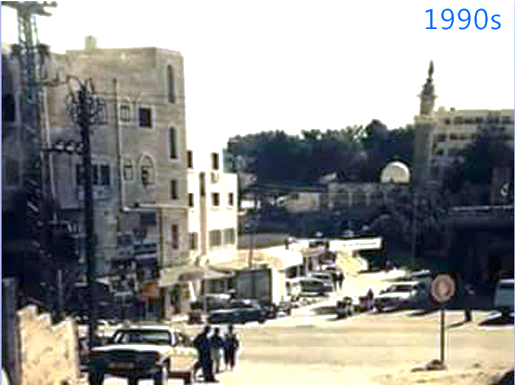
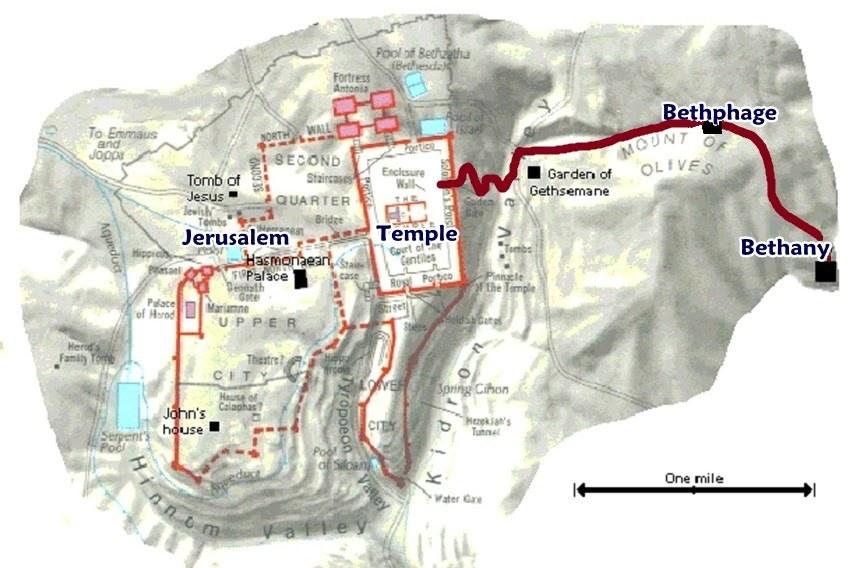
Our Lord's visit for a home-cooked meal left a lasting impact on even the smallest of towns. Bethany still suffers from religious tensions of her nearest neighbor, the Jerusalem which now is, and is in bondage with her children. The spades of the archaeologists disclose an odd course of growth over the years.

Our Lord's visit for a home-cooked meal left a lasting impact on even the smallest of towns. Bethany still suffers from religious tensions of her nearest neighbor, the Jerusalem which now is, and is in bondage with her children.The spades of the archaeologists disclose an odd course of growth over the years.


Map of Bethany.  Source: TruthInScripture.net

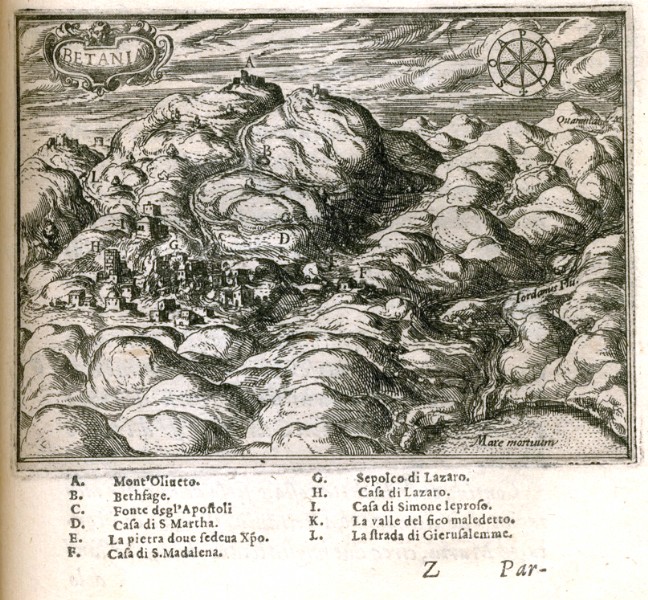
Bethany, depicted in 1587, by Jean Zuallart.  Wikipedia commons.

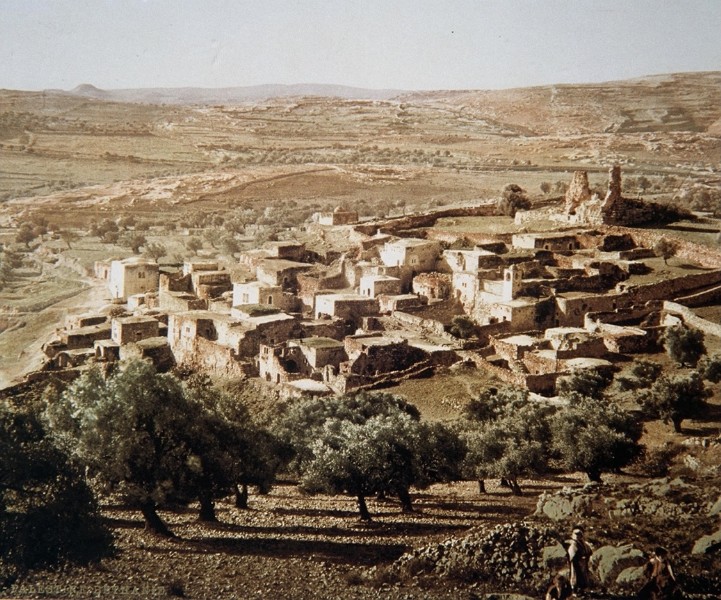
Most archaeological digs have merely uncovered more details of 4th century churches built near Lazarus' former tomb, to immortalize Jesus' miracle.  In fact, all of the sites we read about in Scripture were venerated over the years, as a map from 1587 shows (left). Though written in Latin, you can make out the names of the Mount of Olives (A), the houses of Martha (D) and Simon the leper (I), and Lazarus' tomb (G).  As recently as 1890, the little village still had that small town look and feel (right top photo).


Colorized photo of Bethany, Felix Bonfils, circa 1890. Wikipedia commons.

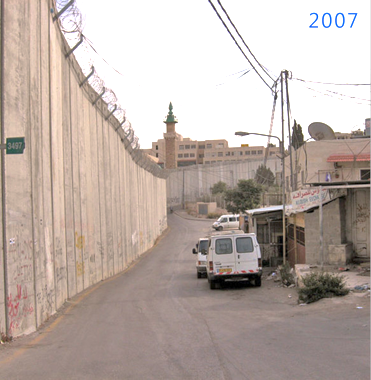
The town still exists today, having grown from a rough mountain hamlet of 12-20 families, to the second largest Palestinian city in the Jerusalem Governate for a population of over 17,000 mostly Palestinian families. Known as Al-Eizariya (Arabic for "The place of Lazarus"), it now has a large Jewish/Palestinian wall as a security barrier (below), due to its proximity to the Temple Mount. Thankfully God's elect dwell in the Jerusalem which is above and is free, protected by Jesus.

Israeli separation barrier between modern-day Bethany and Jerusalem.  Wikipedia commons.


Like this? Consider sharing it to Facebook by clicking the linked icon below.

Archaeologists looking for ancient biblical cities rely on the discovery of walls, gates and pottery.  The identification of Sodom and Gomorrah is more elusive, since God overthrew those cities, and all the plain, and all the inhabitants of the cities, and that which grew upon the ground. Peter says He turned the cities of Sodom and Gomorrah into ashes.


Archaeologists looking for ancient biblical cities rely on the discovery of walls, gates and pottery.  The identification of Sodom and Gomorrah is more elusive, since God overthrew those cities, and all the plain, and all the inhabitants of the cities, and that which grew upon the ground. Peter says He turned the cities of Sodom and Gomorrah into ashes.


The Bible insists we can see Sodom's ashes, as they were left behind for an ensample, meaning a visible exhibit of warning. Two ancient writers indicate such is the case. Josephus wrote of "... Zoar in Arabia.  The country of Sodom borders it.  Now this country is then so sadly burnt up, that nobody cares to come at it ... It was of old a most happy land, both for the fruits it bore and the riches of its cities, although it be now all burnt up. It is related how for the impiety of its inhabitants, it was burnt by lightning; in consequence of which there are still the remainders of that divine fire; and the traces (shadows) of the five cities are still to be seen ... marks of credibility which our very sight affords us."  The well-known William Albright and his colleague, Dr. Melvin Kyle, set out to find the cities in 1924.  Of their findings at the southern end of the Dead Sea, Dr. Kyle wrote, "...a region on which brimstone was rained will show brimstone. Well, it does; we picked up pure sulfur, in pieces as big as the end of my thumb. It is mixed with the marl of the mountains on the west side of the sea, and now is to be found scattered along the shore of the sea even on the east side, some four or five miles distant from the ledge that contains the stratum. It has somehow scattered far and wide over this plain." [1] In 2018, Forbes magazine reported on 13 years of archaeological research just north of the Dead Sea, where "samples from the site show that an extremely hot, explosive event leveled an area of almost 200 square miles ... not only wiping out 100 percent of the Middle Bronze Age cities and towns, but also stripping agricultural soils from once-fertile fields."  [2] How hot?  The researcher says, "perhaps as hot as the surface of the sun", which is around 6-10,000 degrees F.  


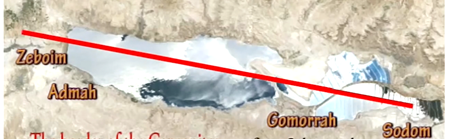
Regarding their exact location, our best clue comes from Genesis 10:19 which says the border of the Canaanites was from Sidon, as thou comest to Gerar, unto Gaza; as thou goest, unto Sodom, and Gomorrah, and Admah, and Zeboim, even unto Lasha. 1 Samuel 13:18 indicates Zeboin was south of Jericho, placing it to the north end of the Dead Sea.  Thus, these five cities were located roughly in a line, but scholars debate on which side of the sea to locate the line (see below).


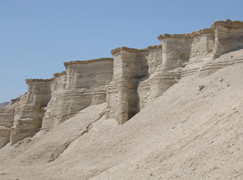
In October of 1990, Ron Wyatt discovered strong evidence on the western side. He found unnatural right-angled ghost cities [1] (below) made of a flaky, powdery substance. Chemical analysis determined it to be calcium carbonate and calcium sulfate" the product of burning limestone and sulfur at temperatures above 2,200 deg. F. This material contains golf ball-sized chunks of 96-98% pure sulfur, atypical from the area's geothermal sulfur nodules at only 40% purity.  These balls are encapsulated in a reddish-black, crusty ring where it suffocated. If pried out, one of these heavenly balls of wrath can still be lit, emitting a stinky blue flame. Evidence indeed!


Like this? Consider sharing it to Facebook by clicking the linked icon below.

Patriarchal acts of faith in the promises of God at times left interesting records. Such is the case in the life of Joseph, who made the children of Israel swear, saying God will surely visit you and ye shall carry up my bones from hence.

     Patriarchal acts of faith in the promises of God at times left interesting records. Such is the case in the life of Joseph, who made the children of Israel swear, saying God will surely visit you and ye shall carry up my bones from hence. In his well-documented "Patterns of Evidence: Exodus" movie, Tim Mahoney chronicles not only evidence for a large Semitic exodus from Egypt but also the spectacular discovery of Joseph's tomb. Mahoney brings to light the interpretations of archaeologist Edward Rohl who finds stunning alignment between an Austrian archaeologist's finds at Tell ed-Daba and the Bible's account of Joseph in Genesis. 
 

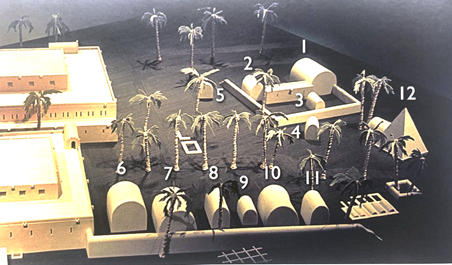
 Model of Palace garden cemetery, showing 12 principal tombs, where #12 is a pyramid typically reserved only for prominent Egyptians

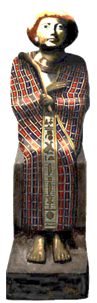
     Rohl writes, "Without searching for it... and it has to be said, without realizing it ... the Austrian archaeological mission at Tell ed-Daba had found the lost city of the Israelites located at the heart of the biblical land of Goshen. They had unearthed the house of Jacob and the palace of the vizier Joseph with its twelve-columned facade representing the twelve sons of Jacob. They had found twelve main tombs in the palace garden, one of which was a pyramid tomb with a colossal cult statue of its occupant, which once stood in the chapel attached to the tomb. They had discovered that the burial chamber had been accessed in antiquity via a tunnel and the entire contents - including the body - removed. The tomb had not been plundered but, nevertheless, it was empty. The colossal cult statue had been smashed into pieces and parts had rolled into the tunnel. This statue had been made in the royal workshops of Amenemhat III in whose time there had been a prolonged famine caused by a series of high Nile inundations. The cult statue represented an Asiatic [Semitic] official with yellow skin and sporting an Asiatic throw stick as his scepter. He had flame-red hair. And he wore a coat of many colors. Short of finding a name on the missing part of the statue, I could only come to one conclusion... this complex in Tell ed-Daba Area F was the home and tomb of Joseph the Asiatic vizier famous for his multicolored dream coat and the man who brought the Israelites into the land of Goshen - the foreigner who had saved Egypt from the great famine and who had been rewarded by Pharaoh with a magnificent pyramid tomb in the heart of the Asiatic city of Avaris." [1]

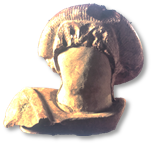
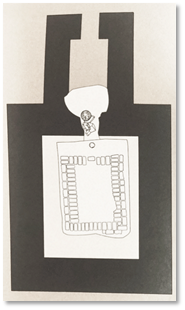
Left: remains of the Joseph funerary statue; Center: diagram of pyramid tomb with platform (brown) and burial chamber; Right: reconstruction of the colossal statue, with multicolored cloak, yellow skin, red hair, Asiatic staff, and Egyptian titles in front


Who'd have thought that another empty tomb would be so significant?


[1] Quote, figures and diagrams excerpted from chapter 7 of David Rohl, Exodus: Myth or History?, Thinking Man Media, 2015, St. Louis Park, MN.


Like this? Consider sharing it to Facebook by clicking the linked icon below.

At this particular season, Christians worldwide rightly celebrate the resurrection of Jesus Christ. It is inarguably the decisive, defining event which anchors the hope of all believers.

At this particular season, Christians worldwide rightly celebrate the resurrection of Jesus Christ. It is inarguably the decisive, defining event which anchors the hope of all believers. Jesus spoke often of heaven, hell, and the afterlife.  His resurrection from the dead, the greatest of all miracles, validates all of what He spoke and who He claimed to be, giving far greater weight to His words. Never man spake like this man.


The Bible points out clear evidences of Jesus' resurrection, especially the absence of a dead body. In fact, the disciples' chief adversaries did not reject the fact of the empty tomb, but implicitly accepted it when the chief priests instructed the soldiers, say ye, his disciples came by night and stole him away while we slept. The easiest way to dispel Jesus' resurrection, the mere display of Jesus' body, will never occur. He alone will reveal Himself in that great day.


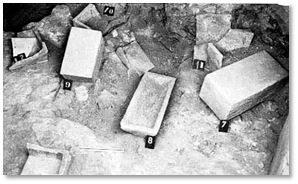
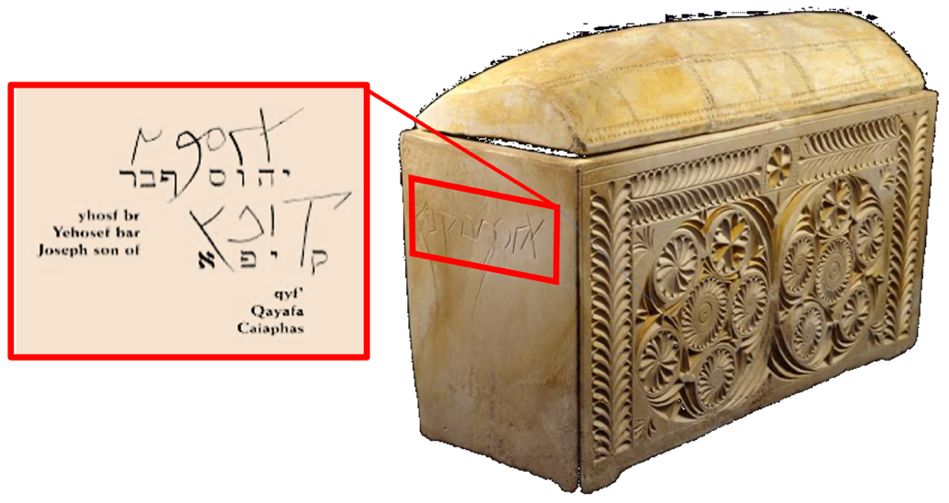
However, it is curious that the archaeologist's spade found another set of bones, those of Jesus' chief antagonist and judge, the high priest Caiaphas. In November 1990, a bull-dozer digging to build a water park in the Jerusalem Peace Forest hit the ceiling of an ancient Jewish burial cave containing 12 ossuaries, or bone boxes (right). A Christian historian explains ossuaries as "a form of burial used ... in the second temple period, and only in Jerusalem.  The process was to bury the body temporarily in a tomb until the body decayed, and only the bones remained.  The bones were then placed in a stone box along with the rest of the family in the family tomb.  Their use ended with the Roman destruction of Jerusalem in 70 A.D." [1] 


One highly ornate ossuary was found. Inside it contained the bones of a man about 60 years of age, along with other skeletal remains of what presumably were other family members.  It had the same inscription in Aramaic (the native language of the Hebrews in Jesus day) on two sides of the box: "Joseph, son of Caiaphas" (below).

A biblical archaeologist explains the significance of this find:  "Could this be Caiaphas the high priest who presided over Jesus' trial?  At first blush it would appear that the answer is no since the inscription identifies the man as the son of Caiaphas.  But Josephus identified the man who presided as high priest in Jesus' day as 'Joseph Caiaphas.'  Josephus said he held this office from AD 18-36 (Jewish Antiquities, 18:35).  Later, Josephus refers to him as 'Joseph who was called Caiaphas of the high priesthood' (Jewish Antiquities, 18:95).  Apparently, Caiaphas was the high priest's surname, which became his nickname.  This is similar to the Herod family.  'Herod' was the surname by which multiple sons of Herod were identified." [2] Furthermore, the ossuary is as ornate as might be expected from someone of his rank and family. The evidence is compelling.


The irony is supreme. We have Caiaphas' bones, but not Christ's! Jesus answered and said unto them, Destroy this temple, and in three days I will raise it up. When therefore He was risen from the dead, His disciples remembered that He had said this unto them; and they believed the scripture, and the word which Jesus had said.


[1] https://tentmakingchristianity.com/what-you-should-know-about-the-caiaphas-ossuary/

[2] https://theosophical.wordpress.com/2011/09/21/biblical-archaeology-41-caiaphas-ossuary/

Like this? Consider sharing it to Facebook by clicking the linked icon below.

We at MBC are pleased to provide the conference attendees of the Kept Pure conference with free resources.

For The Kept Pure Conferees

MBC, in conjunction with Holding Fast ministries, is eager and happy to provide free resources for you to further explore the many facets of the doctrine of Verbal Plenary Preservation (VPP).  Fully supported by the Westminster Confession of Faith, as well as the London Baptist Confession of Faith, VPP is the necessary handmaiden of the doctrine of verbal plenary inspiration; for without preservation, inspiration is useless.  The ecclesiastical text (aka, the Textus Receptus) suffers attacks from those promoting the Critical Text -- yet still abides faithful.

At the conference, we provided two books for you to personally take home and study, free of charge:  David H. Sorenson's Neither Oldest Nor Best, and Thou Shalt Keep Them (Kent Brandenburg, ed.).  We have found these to provide stunning, conclusive and insurmountable evidence refuting the mighty men of the Critical Text camp.  If you were unable to take home your free copies this year, we will provide some again for next year's conference.

In the meantime, Holding Fast ministries (the "VPP theological arm" of Mission Bible Church) provides some highly relevant and readable information (below).

http://holdingfast.net/Critical-Text

An overview of the commonly overlooked issues with the Critical Text.  Plus, we offer a guided tour to the online versions of Sinaiticus and Vaticanus, which even Westscott and Hort never saw (that's right - they worked from Tischendorf's copy, not the original A or B mss).

http://holdingfast.net/ESV-Corrupts-Doctrine

The lie is oft-repeated that no doctrinal impacts are to be found in the critical text (and subsequently other translations).  The author spent 2 years researching impacts to the various Reformed confessions, and found over 30 impacts, with 6 doctrines irretrievably lost. (The quickest way is to review the PowerPoint slides, then skip to the video where a slide of interest is discussed further.)

http://holdingfast.net/Canon

This is for those totally new to the issue, and need some fundamentals laid first before enterring this unnecessarily confusing web known as higher text criticism.

https://www.keptpure.com

This is conference site.  Pas. McShaffrey, conference host and Pastor of Five Solas church in Reedsburg, WI, will post the messages (hopefully) in the near future.


The people of God have never been popular, and at every turn, men have sought to hold (suppress) the truth in unrighteousness.

The people of God have never been popular, and at every turn, men have sought to hold (suppress) the truth in unrighteousness.  Yet God often turns man's ways back around, converting his buffoonery to our credit. Surely the wrath of man shall praise thee (Ps 76:10a).  One example is that of Jesus' physical cross, and whether He was crucified on a stake, as the Jehovah Witnesses claim, or a traditional Roman crossbeam-styled cross. 

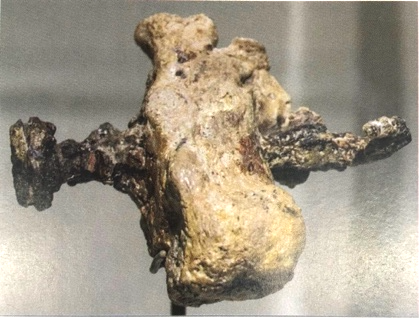
It was the Assyrians who were first recorded to impale their victims on stakes, but the Romans later perfected this to a degree of cruelty that exacted the most suffering over the longest period of time. Yet we find practically no archaeological remains of any skeletal evidence of crucifixion, even though many ancient texts refer to the practice. Two interesting pieces have survived: a 1st century AD ankle bone bearing an iron spike (left, with reconstruction to the right), and some Roman graffiti. The skeletal remains belonged to a man in his mid 20s, and the inscription on his ossuary (bone box) noted him as 'the one hanged with knees apart'. It is compelling evidence of this gruesome practice.  But was his cross just a stake, since only the ankle held a nail?


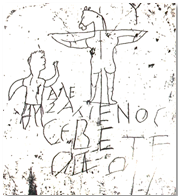
The 2nd piece suggests otherwise of the practice.  Clive Anderson and Brian Edwards wrote: "Crucifixion became a symbol of contempt and derision in the early centuries of the Christian church. The dishonor of crucifixion and Christ riding into Jerusalem on a donkey led to the Christians being referred to as assinari - donkey people. An example of this was discovered crudely scratched on the plaster in a boy's boarding school near the Palatine Hill in Rome (right). It portrays a donkey-headed man on a cross and beside him is a figure with an upraised hand, presumably in worship. The scrawled inscription in misspelt Greek reads, 'Alexamenos worships his god'. Whoever Alexamenos was, he was publicly ridiculed by this graffiti. Close by, someone wrote in Latin Alexamenos fidelis (Alexamenos is faithful) - perhaps by the hand of Alexamenos himself?" 


"The Jews were accused of worshipping their god as a donkey and Christians were associated with this. The Christian leader Tertullian (AD 155-220) commented, 'Some of you have entertained the dream that our god is actually the head of an ass. With biting sarcasm, he continued: You in fact worship the ass in its entirety, not just the head. And then you throw in Epona, the patron saint of donkeys and all the beasts of burden, cattle, and wild animals. You even worship their stables' (Tertullian To the Nations ch II)." [1] Josephus also defended the Jews against similar charges (Against Appion II.7). [2]


The etching clearly depicts a crossbeamed cross, not just a stake.  Though it was intended to mock brother Alexamenos for his faith, it ended up surviving the centuries to debunk a myth of our day, unwittingly contrary to the artist's original intention.


Furthermore, it is fascinating that Scripture predicted Christ's specific means of death.  David wrote 100 years before the start of the Assyrian Empire's existence, and a millennia before Rome's, this Messianic statement:  they pierced my hands and my feet (Psalm 22:16). Zechariah in ~487 BC [3] wrote they shall look upon me whom they have pierced (Zech. 12:10).  This is long before crucifixion was invented. Our Sovereign God ordained even the very means of Jesus' death!


Behind the history lies a greater consideration; namely, Jesus' painful, shameful death on the cross of Calvary. Let us not belittle the seriousness of sin, nor the supreme sacrifice of the Savior. All praise, honor and glory to Him who was obedient unto death, even the death of the cross, and conquered death, hell, Satan – and all false accusers.


[1] Description adapted from Clive Anderson and Brian Edwards, Evidence For The Bible, Day One Publications, 2014, p.138-139. Pictures from the same.

[3] Date from Rose Publications "Bible Time Line" pamphlet, © 2001 RW Research.

Like this? Consider sharing it to Facebook by clicking the linked icon below.

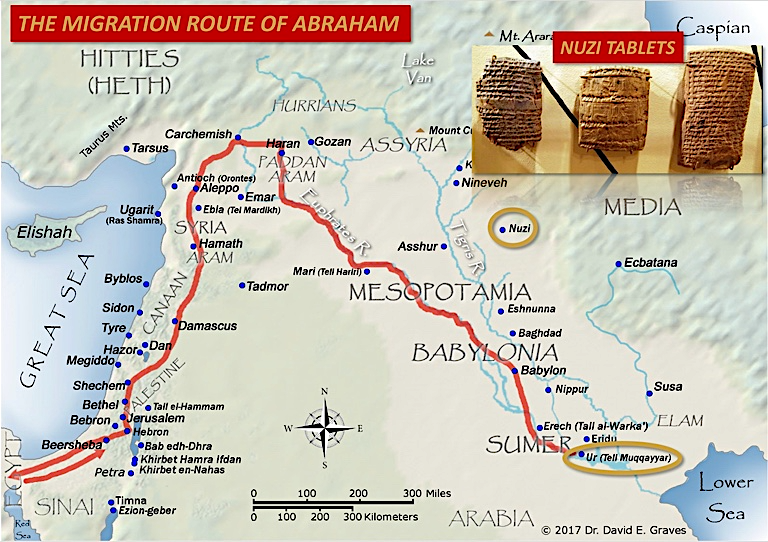
Nuzi, a mound 150 miles directly north of Baghdad, Iraq, was excavated in 1925-1931 by a joint expedition of the American School of Oriental Research in Baghdad, Harvard University, and the University of Pennsylvania Museum.

"Nuzi, a mound 150 miles directly north of Baghdad, Iraq, was excavated in 1925-1931 by a joint expedition of the American School of Oriental Research in Baghdad, Harvard University, and the University of Pennsylvania Museum. Dr. Edward Chiera was the director. The soundings reached virgin soil, yet the level of occupation uncovered was the 15th to 14th centuries B.C. when the city was populated by the Hurrians, who were the long-lost Horites of the Old Testament."

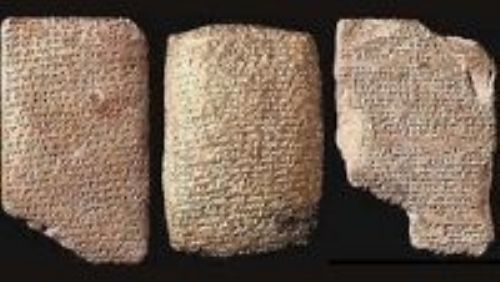
"From the palace and from wealthy private homes, they recovered ~20,000 clay tablets written by Hurrian scribes in the Babylonian cuneiform lan-guage, but with the occasional employ-ment of native Hurrian (Horite) words. The tablets consisted largely of commercial accounts, contracts, reports, and judicial decisions which revealed the way of life for some leading families for four or five generations. The parallels between the customs and social conditions of these peoples and the patriarchal narratives in Genesis were not only remarkable but have proved to be one of the external factors supporting the historicity of this section of the Bible. The patriarchs came from this general section of the country, and had lived at Haran, (which was predominantly Hurrian or Horite). They had maintained contact here for generations afterward, and in the absence of laws and customs of their own (for there was, as yet, no Old Testament written), they followed those to which they had been accustomed.  Notice some of the parallels:"


"(1) Exchange of Property. All transactions involving the transfer of property were recorded, witnessed, sealed, and proclaimed at the city gate (Gen. 23:10-18)."

"(2) Marriage Contracts included a statement that a handmaid could be presented to the new bride, as was the case with Leah and Rachel (Gen. 29:24, 29), and contained a provision obliging a childless wife to provide her husband with a handmaid who would bear children, as Sarah gave Hagar to Abraham (Gen. 16:3), and Rachel gave Bilhah to Jacob (Gen. 30:3-6)."

"(3) Adoption was practiced at Nuzi when a childless couple would adopt a son who would care for them while they lived, bury them when they died, and be heir to their estate. It was specified that if they ever had a son of their own, then the adopted son took second place. This seems to explain Abraham's adoption of Eliezer as his heir before the birth of Isaac, and the subsequent change when the Lord promised that a son of his own would be born to become his heir (Gen. 15:2-4)."

"(4) Birthright. A contract was found where one brother gave another 'three sheep in exchange for his inheritance share' in a plantation. This sounds like Jacob's gift to Esau of bread and a pottage of lentils (Gen. 25:30-34). Also, the 'blessing' of a dying father in bequeathing property to a son was honored in court where there was a witness to corroborate the father's words (Gen. 27:30-33, 49:1-28)."

"(5) Inheritance. In Nuzi there was a law that implied that property and leadership of the family could pass to a daughter's husband, providing the father had handed over his household gods to his son-in-law. Recall when Laban overtook Jacob and anxiously searched his camp for the household idols, and he could not find them for Rachel had taken the images [teraphim], and put them in the camel's furniture, and sat upon them (Gen. 31:34)."  Chuck Missler suggested "the teraphims indicated land ownership, not so much idol worship.  In case of a land dispute, the boundary markers prevailed." [2]

It is impressive that God raised Abraham within the Horite culture as a crucible for his life, leaving only specific records in scripture as an enduring teacher and pointer to Christ.  When time erases America's customs away, what will be seen of God's handiwork in our lives?


[1] Description adapted from The Thompson Chain Reference Bible, 5th edition, B. B. Kirkbride Bible Co., Inc, 1988, Archaeological Supplement #4420 (p.1779-1780). Map and pix from https://biblicalarchaeologygraves.blogspot.com/2014/12/map-2.html.

[2] Source: Chuck Missler's audio studies in Genesis, https://chuckmissler.com

Like this? Consider sharing it to Facebook by clicking the linked icon below.

The Tel el-Armana (mound of Armana) lay halfway between Memphis and Thebes, and was the remains of Pharaoh Akhenaton's model capital city which was spoiled and left to ruin around 1358-50 B.C.

The Tel el-Armarna Tablets

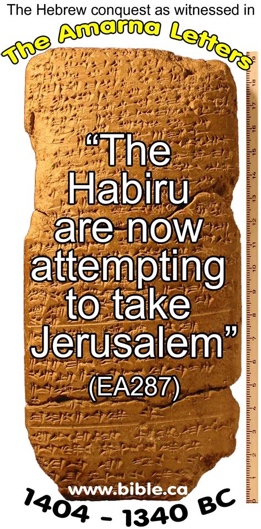
"The Tell el-Armana (mound of Armana) lay halfway between Memphis and Thebes, and was the remains of Pharaoh Akhenaton's model capital city which was spoiled and left to ruin around 1358-50 B.C.  In 1887, a peasant woman dug for fertile soil in the mound and uncovered the royal archives of Amenhotep III, and his royal son Amenhotep IV, who early in his career changed his religion and became known as Akhenaton.  (He had a famous long-necked wife named Nefertiti.) Eventually, more than 350 cuneiform tablets were recovered, most of which were frank personal letters and dispatches from kings, governors, and officers located in cities and fortresses of Babylonia, Mitanni, Phoenicia, Syria, and Palestine.  They were written between 1400 and 1358 BC and sent to these two pharaohs at the Egyptian court. They are from 2-3 inches wide, and 3-9 inches long, inscribed on both sides."


"The Tell el-Armana tablets have proved exceedingly important in the field of biblical research. Many regard them as constituting the most important discovery ever made in Egypt. The very fact that most of these tablets were written in Babylonian cuneiform, even though they came from various countries, indicates that the Babylonian cuneiform was the one general system of writing readily understood by almost all the people of Bible lands during that particular period.  Thus, biblical characters could converse rather freely with the various peoples as they moved from country to country, just as depicted in the OT. For instance, when Abraham came to Syria, Canaan, and Egypt, he could speak to Pharaoh, Sodom's king, Eliezer and Hagar (Gen. 12:18, 14:22, 15:2, 16:3)."


"As to the contents, the clay tablets described Palestine and the surrounding countries as being in a state of turmoil within, and as being attacked from without.  For example, the governor or officer in charge at Gezer wrote to the pharaoh saying, in part: Let my lord the king, the sun in heaven, take heed unto his land, for the Khabiri are mighty against us; and let the king, my lord, stretch out his hand unto me and let him deliver me from their hands, so that they may not make an end of us."
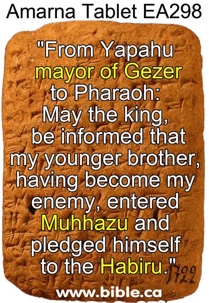
 

"A number of letters from Abdi-Heba, governor of Urusalem (Jerusalem), pled for help from Pharaoh Akhenaton to prevent the country from being lost to Egyptian rule.  In part, one of the letters read: To the king my lord, say.  Thus saith Abdi-Heba thy servant.  At the feet of the King, my lord, seven time and seven times I prostrate myself ... The whole land of the King has revolted.  There is not one governor that is loyal to the King, all have rebelled.  May the King harken unto Abdi-Heba and send troops, for if no troops come this year, the whole territory of my lord the King will be lost.  The Habiru are capturing the fortresses of the King.  May the King care for his land.  The Habiru are taking the cities of the King ... If there are no archers this year, then let the King send a deputy that he may take me to himself together with my brothers and we die with the King, our lord."
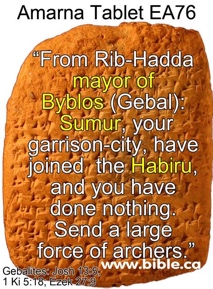
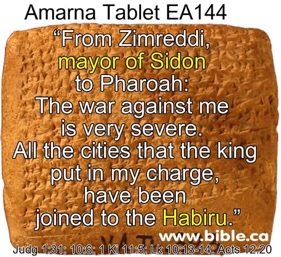
 

"These tablets frequently use the name Habiru in speaking of those who were overrunning the country.  Many of the very finest scholars regard the Habiru (or, Khabiri) as the Hebrews, and the whole framework fits in well with the early date (1400 B.C.) for the beginning of the Hebrew conquest of Canaan under Joshua.  The picture of the invaders fits the Hebrews so well that is has been said, 'Here we have a story of Joshua's conquest of Canaan from the enemy's side.'" 


Indeed, we do!  Visit Bible.ca [2] for a thorough comparison between the tablets and Joshua's history of the Canaanite conquest.


[1] Description adapted from The Thompson Chain Reference Bible, 5th edition, B. B. Kirkbride Bible Co., Inc, 1988, Archaeological Supplement #4328 (p.1721, 1724).

Like this? Consider sharing it to Facebook by clicking the linked icon below.

It is exceedingly rare to encounter ancient relics which provide a visual glimpse of Israel's past.

The Black Obelisk of Shalmaneser III

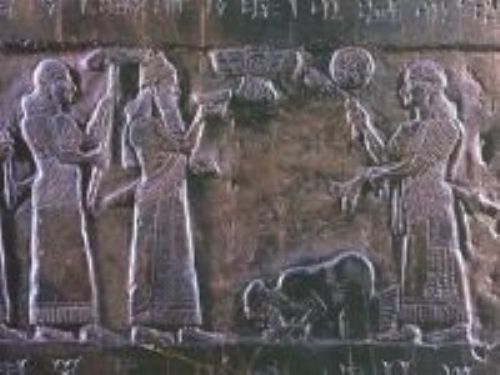
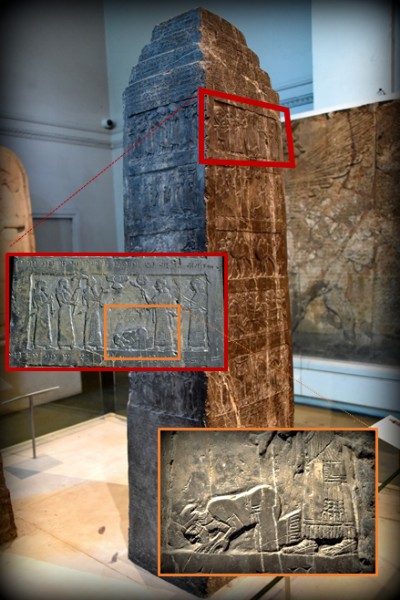
It is exceedingly rare to encounter ancient relics which provide a visual glimpse of Israel's past.  Such is the case of the obelisk of Assyrian king Shalmaneser III (right), who received tribute from king Jehu in ~841 BC and is depicted while bowing in servitude. This large artifact, housed at the British museum, was discovered by archaeologist Henry Layard in 1846 while excavating in Nimrud, Iraq near the site of the ancient Assyrian capital Kalhu. This could be the only "photo" of a Jewish king!


This black alabaster monument records 31 years of military his victories and includes bas-reliefs of tributes paid by five conquered regions. A caption written in cuneiform over our scene of interest reads: "The tribute of Jehu, son of Omri: I received from him silver, gold, a gold bowl, a gold vase [with pointed bottom?], gold goblets, gold buckets, tin, a royal sceptre [and] spears." Though Jehu was not Omri's son (he was the son of Nimshi), we know it is the biblical Jehu, as Assyrians would refer to successive rulers in relation to the first ruler with whom they had contact. Jehu's name also appears in numerous other Assyrian inscriptions.


Speaking of first mentions, Jehu appears in 1 Kings 19:16 when Elijah sits discouraged in a cave.  God tells the prophet to anoint Jehu as Israel's king who would judge wicked king Ahab's house. (God also tells Elijah I have left me seven thousand in Israel, all the knees which have not bowed unto Baal.)  We also read of Jehu in 2 Chronicles 22:7-9 and 25:17.


Zealous for the Lord, Jehu began as God promised, as he brake down the image of Baal, and brake down the house of Baal, and made it a draught house (latrine) unto this day. But the damage from king Ahab and his son Joram's unsuccessful wars against now-super power Assyria returned to haunt him, prompting Jehu to align with Assyria in battle against Hazael in Damascus, Syria (2 Kings 8:28). This helps explain why Israel's old ally (now foe) was hostile against Israel; but God records the real reason: Jehu took no heed to walk in the law of the Lord God of Israel with all his heart: for he departed not from the sins of Jeroboam, which made Israel to sin (2Ki 10:31). A sad ending for a king with real potential.

Bas-relief picture ~841 BC, possibly of King Jehu, British Museum of History in London. Photo sources: https://www.bibleodyssey.org/en/tools/image-gallery/b/black-obelisk-kingshipane/,  https://historyetc.org/photos/black-obelisk-of-shalmaneser-iii-british-museum/ and https://biblearchaeologyreport.com/2020/10/09/king-jehu-an-archaeological-biography/.


Like this? Consider sharing it to Facebook by clicking the linked icon below.
Archaeological findings and reconstructions from the ruins of Jerusalem at the time of Jesus and the Apostles is fascinating in its own right.

The Beautiful Gate

Archaeological findings and reconstructions from the ruins of Jerusalem at the time of Jesus and the Apostles is fascinating in its own right. To be able to visualize millennia-old structures provides a connection to the past, and for the Christian, vividly illustrates how God's Word endured the ages far better than man's work. Our faith does not rest on old, weathered stones but on the solid Rock. The gate called Beautiful (Acts 3:2,10) exemplifies this, as scholars don't agree on just what this is!


First, let's review the Biblical data on this gate.  The lame man healed by Peter was at here daily as people passed through to go into the temple at the hour of prayer (v.1), a daily event.  After his healing, he walks and leaps with them into the temple, holding on to Peter and John (v.8), and is soon joined by a crowd in the porch that is called Solomon's, a large flat area just inside the wall.  While this porch bears that name today, there are no other references to this gate other than what we read in Acts 3, nor are any gates in the old city today called by that name. Thus, from what can be surmised, the term Beautiful is the gate's colloquial title, reflecting its beauty. So, all we need to do is identify a beautiful temple gate, right?


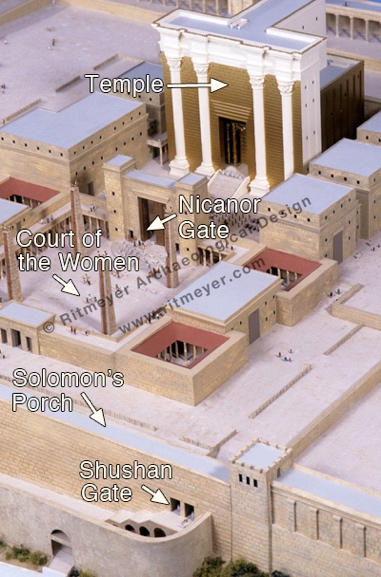
The first century Jewish historian Josephus notes the nine gates and posts were completely overlaid with gold and silver, but one outside the sanctuary was of costly Corinthian bronze. It shown magnificently in the sun. Funded by private citizen Nicanor, it was big and truly stood out. Just inside these single-leafed gates surrounding the inner temple was Solomon's porch, where 13 treasure chests were placed for the tithe, sin, and voluntary offerings.  Surely this is the gate of our beggar!  In addition to Josephus, other historians such as Thackeray, Edersheim and Lightfoot agree.  The diagram [1] to the right shows its relative size and location, as well as a problem which other scholars point out with this selection.  How would the blind man enter this gate with the disciples to get back to Solomon's porch? Temple court rules restricted people with physical issues of blood from getting close to the holy inner temple, potentially restricting his passage, so how would he even get that far to begin with?


Others observe that the word horaios, translated beautiful, doesn't normally mean beautiful.  They suggest the word relates to "golden", meaning a golden gate.  The eastern Sushan gate was both beautiful and golden.  But what's beautiful about a gate so visibly inferior to Nicanor? These scholars point out the Sushan gate is named for an elaborate sculpted relief of the city of Susa and its palace (think of Queen Esther).  When healed, he could easily enter in, climbing a few steps up to Solomon's porch. Detractors point out this inferior gate was mainly used for ceremonial purposes and faced east, not south where nearly all of the city's inhabitants lay; thus, it wouldn't have much traffic.  Archeological purists, not holding the Word as divinely inspired, suggest one of two south gates, double leafed, with ornately sculpted roofs along its entrance, and where most of public traffic came.


One solution for the Nicanor gate is to distinguish between the inner temple and the outer temple.  John Lightfoot [2] points out the Nicanor gate led both into the inner temple as well as back to the outer temple; either way led into the temple.   This makes it a preferred choice.  Spiritually speaking, there is only one gate to God's holiest heaven, the strait gate, while many are the gates of death; and it is this gate of the Lord into which the righteous shall enter.  Thus, spiritual healing occurs outside only one gate.  His physical recovery there typifies salvation magnificently, since he returns to the area of many gates, to do as King David the sweet Psalmist was inspired to write, that I may shew forth all thy praise in the gates of the daughter of Zion: I will rejoice in thy salvation.


[1] Drawing: Leen Ritmeyer, archaeological architect who labored 30 years on modelling the temple; https://www.ritmeyer.com/2010/12/14/the-beautiful-gate-of-the-temple/

[2] John Lightfoot (1649), "The Temple Service As It Stood In The Dayes of Our Saviour"; from https://www.bible-history.com/court-of-women/beautiful_gate.html

Like this? Consider sharing it to Facebook by clicking the linked icon below.