In 931 BC, Solomon's United Kingdom was split into two parts, with Jeroboam taking rule over 10 tribes to the north with its pristine land and proximity to vital trade routes, while Rehoboam had the two southern tribes of Judah and Benjamin, where worship rightfully occurred at Jerusalem. But the northern king could not have his people traveling to a different kingdom to worship, so he set up idolatrous worship in the land of the tribe of Dan, a place accustomed to such practices.
It all started hundreds of years before Jeroboam was born, when Micah's idolatry was transplanted to Dan (Judges 17-19). Jonathan, the grandson of Moses, founded a dynastic pagan priesthood which endured until the tribe of Dan went extinct (Judges 18:30). [1] Archaeologist A. Davis in 2013 noted, "While it is clear Jeroboam set up an altar at Bethel and Dan, most Bible students fail to realize that he inherited and modified the pagan altar at Dan that had functioned for 420 continuous years before him. The archeology at Tel Dan (Laish) provides us with an incredible window into the ancient pagan history of the tribe of Dan in 1350 BC and Jeroboam in 930 BC." [2] It seems Dan fulfilled Jacob's prophecy as a serpent by the way, an adder in the path, that biteth the horse heels, so that his rider shall fall backward, as he sowed the seeds of apostasy enabling pagan worship throughout the ages. So bad was the idolatrous worship, that God raised up the Assyrians to destroy and take captive the northern kingdom, altars and all, in 722 BC.
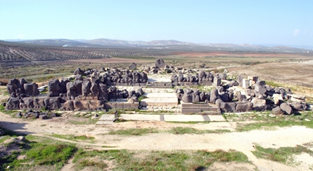
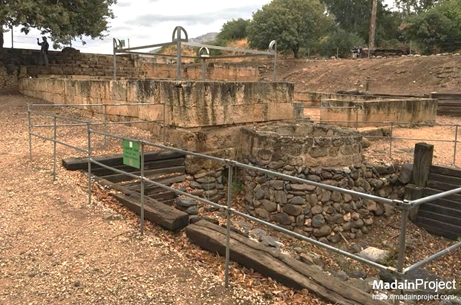
So effective was God's destruction of these altars, that none were found until 1970. Archaeologists discovered carved stone in a rectangular block pattern, steps leading to a raised altar area, a round cistern (foreground, picture to the right) for ceremonial washing, and the remains of the altar base. Today, one sees a steel frame erected on top of the altar's base to give the outlines of what it could have looked like. The pointy things in the corner are the "horns of altar." Although there is some debate as to the exact shape of the horns, their purpose was to bind the sacrifice and keep it tied to the altar while the pagan priest did his job.
Though small by modern standards, and seemingly insignificant, the altar at Dan was a big deal to God, Who insisted that worship must occur on His terms, under His conditions, at His specified location, and by His ordained priests. Dan's association with idol worship is likely why he's missing from the list of tribes in Rev. 7:5-8, to underscore God's hatred of idol worshipers. Yet we have an altar, whereof they have no right to eat which serve the tabernacle. For the bodies of those beasts, whose blood is brought into the sanctuary by the high priest for sin, are burned without the camp. Wherefore Jesus also, that He might sanctify the people with His own blood, suffered without the gate. Let us go forth therefore unto Him without the camp, bearing His reproach. For here have we no continuing city, but we seek one to come.
There's a reason we take worship seriously here at MBC!
|
Altar at Tel Dan, base of Mount Hermon, near the headwaters of the Jordan river. Steel frame provides an illustrative outline of the 4-horned altar. |
[1] Source: https://www.bible.ca/archeology/bible-archeology-tel-dan-laish-leshem-micah-Jonathan-jeroboams-king-of-israel-high-place-altar-temple-1340-723bc.htm
[2] Quote, and all photos, from https://madainproject.com/cultic_altar_(tel_dan). Dates from Rose Publications Bible Timeline pamphlet", 2001, RW Research Inc.
Like this? Consider sharing it to Facebook by clicking the linked icon below.
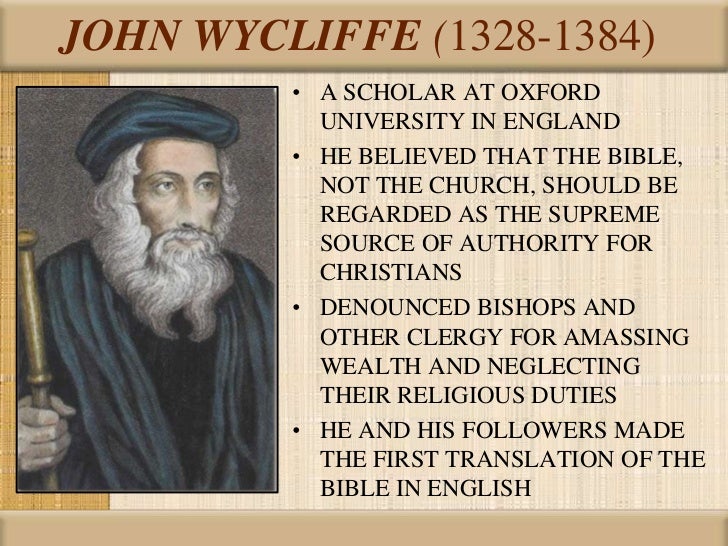
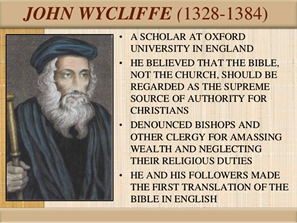 answer is found in John Wycliffe.
 ycliffe died of a stroke in Dec. 1384. So great was his impact that 31 years later, the Council of Constance declared him a heretic, and in 1428 they exhumed his corpse, burned it, and cast his ashes into the River Swift. A later historian noted,
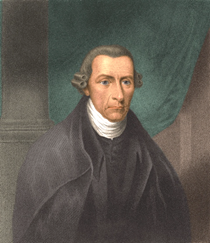 The Bible shaped his life and work, and Patrick Henry himself realized the gospel was shaping the identity of his new nation. Here is his observation in 1765 before the Virginia House of Burgesses: "It cannot be emphasized too clearly and too often that this nation was founded, not by religionists, but by Christians; not on religion, but on the gospel of Jesus Christ. For this very reason, peoples of other faiths have been afforded asylum, prosperity, and freedom of worship here." Patrick Henry recognized that protections and prosperity grow out of freedom of conscience within society. There is no standard for freedom nor guarantee of it unless it is rooted in the fear of God and the belief that God's plan of salvation redeems souls to be free in Christ.