Missives

A collection of apologetic and encouraging notes for Christians in need of some power-boosts from time to time.

God's Word speaks much about our tongue and its use. We read that counsel in the heart of man is like deep water; but a man of understanding will draw it out.

God’s Word speaks much about our tongue and its use. We read that counsel in the heart of man is like deep water; but a man of understanding will draw it out.  Several excellent aids to “draw out” the thought processes which drive a tongue’s reaction came across my desk this week (primarily from my son’s Landmark Freedom Baptist homeschool curricula) [1] which I thought to share.  Consider posting these nearby as I have.


This short list offers easy-to-digest tips which admonish and reprove how we are to mentally treat others before speaking.  Which do you need to be reminded of the most?


Slow to suspect - quick to trust

Slow to condemn - quick to justify

Slow to offend - quick to defend

Slow to expose - quick to shield

Slow to reprimand - quick to forebear

Slow to belittle - quick to appreciate

Slow to demand - quick to give

Slow to provoke - quick to help

Slow to resent - quick to forgive


This next short poem should prevent us from getting “The Selfie” award, where our speech tends to be about ourselves, our woes, and our lives.  Christians are to love one another, and not be desirous of vain glory. One approach is to consider one another to provoke unto love and to good works. We are to look not every man on his own things, but every man also on the things of others.  When another Christian’s speech falls short of this mark, God through Paul exhorts us to [forbear] one another, and forgiving one another, if any man have a quarrel against any: even as Christ forgave you, so also do ye.  Consider taking one stanza of the poem and use it to construct a bridle for your tongue this week.


A Memory System

Priscilla Leonard


Forget each kindness that you do

As soon as you have done it;

Forget the praise that falls to you

The moment you have won it.

Forget the slander that you hear

Before you can repeat it;

Forget each slight, each spite, each sneer

Wherever you may meet it.


Remember every kindness done

To you, whate'er its measure;

Remember praise by others won

And pass it on with pleasure.

Remember every promise made

and keep it to the letter;

Remember those who lend you aid

And be a grateful debtor.


Remember all the happiness

That comes your way in living;

Forget each worry and distress,

Be hopeful and forgiving.

Remember good, remember truth,

Remember heaven's above you,

And you will find, through age and youth,

True joys and hearts to love you.


[1] Landmark Freedom Baptist, Personal Development For Young Men, 2016, pgs. 23, 67


Like this? Consider sharing it to Facebook by clicking the linked icon below.

In the Bible, God makes much of His role in human history, especially of the Israelites. Unbelieving academics professing themselves to be wise attack God by undermining the historical reliability and accuracy of the Bible.

In the Bible, God makes much of His role in human history, especially of the Israelites. Unbelieving academics professing themselves to be wise attack God by undermining the historical reliability and accuracy of the Bible. For instance, two respected archaeologists wrote: “… the emergence of early Israel was an outcome of the collapse of the Canaanite culture, not its cause. And most of the Israelites did not come from outside Canaan - they emerged from within it. There was no mass Exodus from Egypt. There was no violent conquest of Canaan. Most of the people who formed early Israel were local people -the same people whom we see in the highlands throughout the Bronze and Iron Ages.” [1]


This leads some to doubt the Bible’s veracity with a poisonous seed of unbelief: if the Bible is not right about history, whose artifacts we can see, why trust God in matters we cannot see? This pits the Bible against the scholar, and too often the latter wins over weak Christians.


Upon what do these scholars base their conclusions? It turns out their foundation hinges upon Egypt’s timeline of dynasties. Apparently, all Middle Eastern history is dated in reference to Egyptian chronology. How reliable is that? It turns out, not very. The only undisputed anchor date is when the Assyrian King Ashurbanipal sacked Thebes in 664 BC, but since 1971, researchers are finding big problems with the other anchor dates.


1 Kings 6:1 places the Exodus at 1446 BC.  This date aligns with Israel’s period of the Judges, Jewish Sabbaticals and Jubilee calendar. It is, however, wildly out of sync with conventional Egyptian chronology, which has the Exodus occurring in the middle of the 18th Dynasty, where there’s no record of its society crippled by plagues and a destroyed army, let alone any foreign Jews conquering Canaanite cities 40 years later.


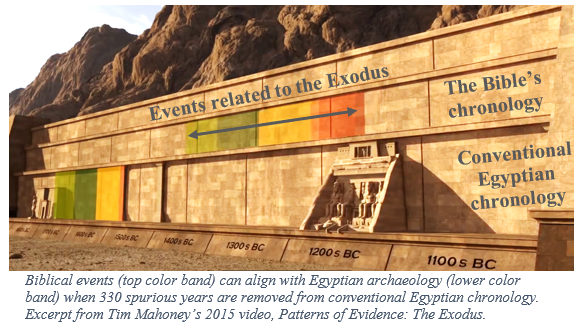
And this is where the half-baked Egyptian calendar begins to crumble.  Why put the Exodus in the middle of a stable Egyptian dynasty? It turns out the Dynasty periods are derived from ancient authors citing Manetho’s list of kings, who wrote of them in the 3rd century BC some 1,200 years after the fact. Conventional Egyptologists have taken those Pharaohs and listed their reigns sequentially; but lately, it’s been discovered that many of them ruled at the same time over different areas. This error accounts for as much as a 330-year over-extension of Egypt’s history (see diagram below, bottom panel). When corrected and thus shortened, there is astounding Biblical alignment.

Christian filmmaker Tim Mahoney captured this new Egyptian chronology by Egyptologist David Rohl (a scholar, not a believer) in a must-watch film, Patterns of Evidence: The Exodus.[2]  When Egypt’s history is corrected, we find stunning alignment between archaeology and the Bible, such as: the inexplicable demise of Egypt’s powerful 12th  Dynasty; an abnormal number of graves with Semitic infant boys; numerous mass graves of all ages, indicative of the firstborn dead; a ruinous hiatus in Egyptian history afterwards; Jericho’s ruins of a collapsed wall and thick ash from a fire; and Gibeon and Hazor’s fiery destruction at the time of Joshua’s arrival. The evidence abounds; unbelieving archaeologists just ascribe it to the wrong period. Wait, this sounds a lot like evolution. We are not ignorant of his devices.


Though Rohl advocates other unbiblical ideas, his new chronology provides a scholarly option for Bible students.  Yet all Christians should be as Titus, holding fast the faithful word as he hath been taught that he may be able by sound doctrine both to exhort and to convince the gainsayers. The Bible always wins in the final analysis.


Like this? Consider sharing it to Facebook by clicking the linked icon below.
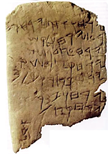
While today's youth stare at a palm-sized device known as a cell phone looking for amusement, young Jewish boys during King Solomon's reign would have looked at a soft limestone tablet of the same size, practicing their writing skills.

While today’s youth stare at a palm-sized device known as a cell phone looking for amusement, young Jewish boys during King Solomon’s reign would have looked at a soft limestone tablet of the same size, practicing their writing skills. A stunning 10th century BC exemplar was found in 1908 by R.A.S. Macalister, 20 miles west of Jerusalem in the ancient town of Gezer.  The Gezer Calendar [1] (right) lists out their annual agrarian schedule, giving insight into their daily lives.


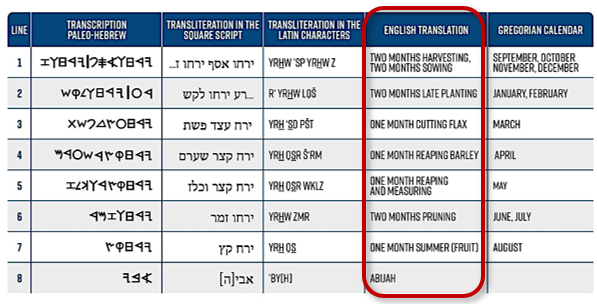
Though originally a rewritable surface, abandonment and hardening over the years now permanently capture seven lines of a schoolboy’s writing assignment. (Girls of antiquity were typically not taught the skill of writing.) The table [2] below deciphers the first 6 lines into Hebrew script, its Latin equivalent, and an English translation, along with our calendar month.  The 7th line reveals the author and his common name: Abijah.

From this short memory aid, we see the Hebrews’ farm calendar began in the time of harvest, coinciding with the Feast of Tabernacles. All Israelites enjoyed this large fall festival which occurred in the 7th month (Tishri), marking the end of the civil year (Ex. 23:16) and the beginning of the next agricultural year (Lev. 23:23-44). Land sabbaths and jubilees, also in Tishri, are likely not mentioned as they were irregular and special events. Rosh Hashanah today corresponds to Tishri 1. [3]


The discovery of an educational device like the Gezer Calendar gives additional insight into training of Hebrew boys. So important was the instruction of their youth that Josephus writes, “Our ground is good, and we work it to the utmost, but our chief ambition is for the education of our children…We take most pains of all with the instruction of children, and esteem the observation of the laws, and the piety corresponding with them, the most important affair of our whole life.” [4]  To denote the Hebrew youth as the most important member of the Jewish society is not an overstatement. A life of instruction was highly valued and remains so today. The Jews began educating their children at the age of 5-7 years old. According to an ancient Rabbinical book, Sayings of The Fathers, the academic curricula was as follows: “At five years old, Scripture; at ten years, Mishnah; at thirteen, the Commandments; at fifteen, Talmud.” No Egyptian learning in here.


This meant scripture memorization began at the earliest possible age, even as Moses commanded. Family attendance at the religious festivals gave the father an additional opportunity to explain Jehovah’s providence in history and promises for the future.


Though not an easy task, faithful Jews understood its value. A Rabbi captured a communal admonition: “Give thyself trouble to learn the Law, for it is not obtained by inheritance.” Apparently this tradition carried on into New Testament, for Paul said of Timothy that from a child thou hast known the holy scriptures, undoubtedly taught him by his mother Eunice.  This admonishment remains relevant today: Set your hearts unto all the words which I testify among you this day, which ye shall command your children to observe to do, all the words of this law. For it is not a vain thing for you; because it is your life. What does this say to our generation, our culture, our nation, and our families?


Like this? Consider sharing it to Facebook by clicking the linked icon below.
What's a ruler to do when the army of a superpower encircles his city, having captured 46 other cities across his nation, and threatens to kill it with thirst and famine?

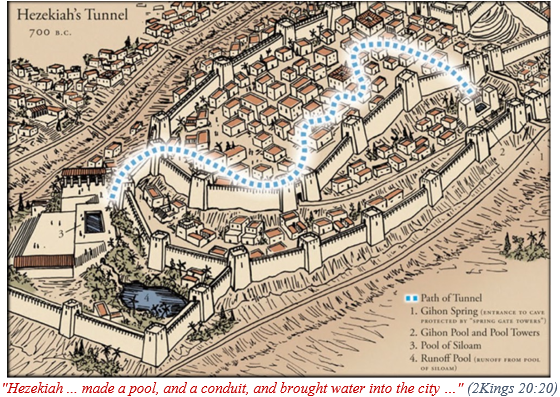
What’s a ruler to do when the army of a superpower encircles his city, having captured 46 other cities across his nation, and threatens to kill it with thirst and famine? No, this isn’t Kyiv; it’s ancient Jerusalem, and king Hezekiah’s solution was simple but hard: cover and protect the Gihon springs outside the city walls, then dig a channel underground all the way to the Siloam pool (see picture below). [1]  Quickly.  Like.  Now.

This tunnel, Hezekiah’s crowning achievement per 2 Chronicles 32:30, was discovered in 1838 by Biblical scholar Edward Robinson. Even back then, it still had over 4-feet of water depth flowing. Today it’s only knee deep in most places.  It took Ed 4 hours to traverse; today, 40 minutes.


Yet it was 16-year-old Jacob Eliahu who found its most famous artifact while skipping classes in 1880.  Using makeshift floats, he entered the tunnel with candles and matches tied to his neck.  When his feeble lamps were snuffed, in total darkness and up to his chin in muddy water, he felt some chisel marks on a submerged wall, 20 feet from the end of the tunnel. Excited, he ran back to tell his school’s headmaster – and it caused quite the stir.  When word got out, vandals sloppily cut the ~18”x30” inscription off the wall and sold it on the Israeli Antiquities market.  Palestine’s ruling Ottoman Turks confiscated it and sent it to the Istanbul Archaeology Museum in 1891, where it remains today. [2]


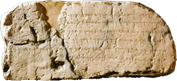
The Siloam Inscription (right) dates to the eighth century (700 BC) based on its grammar, spelling, and paleography (letter style). It refutes all claims from those who deny the significance of Judah’s monarchal period.  The 6-line commemoration translates as: “... the tunnel ... and this is the story of the tunnel. While ... the axes were against each other and while three cubits [were left] to cut ...the voice of a man ... called to his fellow, for there was a through-passage in the rock, from the right ... and on the day of the tunnel [being finished] the stone hewers struck [literally “hit”] each man towards his fellow, ax against [literally: “on”] ax, and the water went from the source to the pool for two hundred and a thousand cubits and one hundred(?) cubits was the height over the head of the stone hewers.”
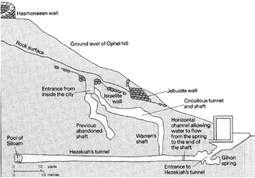
 

Modern engineers offer additional insights (left). The tunnel’s width is only a shoulder wide. The noted length of 1,200 cubits (1,800 feet) is accurate. At 100 cubits (150 feet) below surface, and a ceiling in some places only 6 feet high, meant the workers would have excavated in poorly lit, damp, and cramped conditions. It likely took 6-8 months to dig, with crews working at each end. The men, following a subterranean crack, apparently lost their bearings and dug a large S-shaped path. The water tunnel still functions to this day.
 

And Jacob the discoverer? An orphaned child, he was adopted by Horatio Spafford, who wrote the hymn, “It Is Well With My Soul”.


Like this? Consider sharing it to Facebook by clicking the linked icon below.

Scripture says that in the mouth of two or three witnesses shall every word be established. Archaeologists tend to make great ado about a few shards of pottery, but they really get excited when they discover ancient writings.

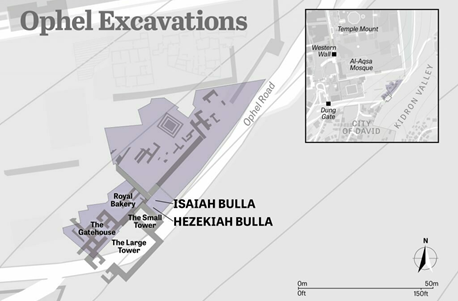
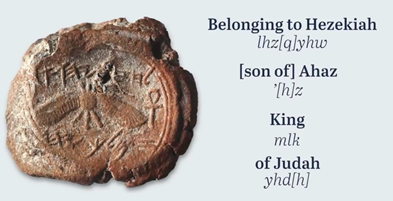
Scripture says that in the mouth of two or three witnesses shall every word be established. Archaeologists tend to make great ado about a few shards of pottery, but they really get excited when they discover ancient writings. Imagine the excitement at two tiny yet stunning finds near the temple in Jerusalem, at a location called the Ophel (see map below), when two clay seals (‘bulla’) bearing the inscriptions of King Hezekiah and Isaiah the prophet, were harvested in 2009. Famed archaeologist Eilat Mazar carefully examined over 30 bullae, yet when these were viewed in microscopic detail in 2014, their true significance exploded. A professional archaeologist of over 50 years, she calls it the greatest discovery of her life.

Hezekiah’s bulla, used to seal authoritative writings with wax- impressions, is a remarkably clear testimony to Hezekiah’s existence.  Very little is missing from the seal, and the Hebrew phrase “Belonging to Hezekiah, son of Ahaz, King of Judah” is readily extracted (see picture).

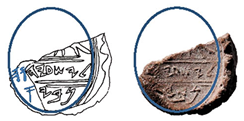
Isaiah’s bulla (pictured right) suffers more damage, though insightful portions remain.  The last letter in the middle section is missing, yet the only option to end the word renders it “Isaiah.” This part of the bulla is undisputed and clear.  It’s the last line that causes a stir.
 

The third lower section reads nvi’, which either means “son of Novi,” or when supplied a missing letter reads nuvi’a meaning “prophet.” Could this be the Isaiah, or some second-class Jew living on the city wall?  Although Isaiah is a relatively common name at that time, it is highly unusual for a private citizen to own a bulla. The ellipse of the seal indicates ample space for the missing letters to form “Isaiah the Prophet.”  Note that it is rare to leave blank spaces in a 1-cm seal.


Isaiah the prophet wrote during the reigns of Uzziah, Jotham, Ahaz, and Hezekiah.  Hezekiah benefited from Isaiah by receiving over 25 chapters of prophecy during his 29-year reign. There are 15 verses where both men appear in the same verse.  Thus, it is not improbable that artifacts from the two might be found together – at the right depth and layer, in the same time period, 1 meter apart. [1]  They being dead yet speaketh, and that, with their authoritative seals for us to find!


Like this? Consider sharing it to Facebook by clicking the linked icon below.

Modern archaeology can be quite frustrating, especially when viewed from the lens of unbelieving yet religious and devout diggers. There is an immense focus on pottery shards, bowls, and large wall-forming blocks, since that accounts for most of the ancient ruins.

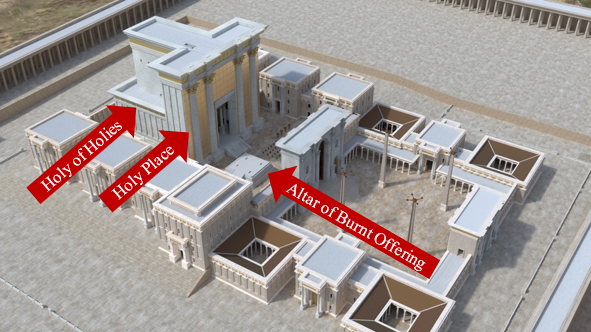
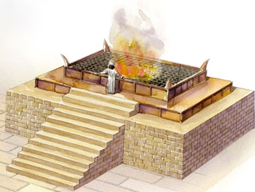
Modern archaeology can be quite frustrating, especially when viewed from the lens of unbelieving yet religious and devout diggers. There is an immense focus on pottery shards, bowls, and large wall-forming blocks, since that accounts for most of the ancient ruins. For places such as Jerusalem, pillaged and burned by the Romans in 70 A.D. then later bulldozed by the Arab Muslims, fragments of these are the most one could hope for. Thus, depictions of Jerusalem’s Herodian temple and altars (below)[1] are aimed to determine the basic structural layouts, with meticulous drawings deduced from biblical texts, Jewish tradition and writings, and findings of detailed archaeological discoveries.

God’s focus, however, was not so much on the structure as it was on the sacrifice. The building was the place where God’s name was, and where the people through their mediator (the high priest) could meet with God to beseech Him for help. To do that, you had to have a sacrifice. It had to be a perfect yet bloody sacrifice.  It had to be in God’s named place and time, at the hand of God’s high priest who was born in the right family.  If anything was off, none of it was acceptable to God without appeal.


Frankly, the entire sacrificial system is rather bizarre when God is taken God out of the picture. Animal sacrifice is certainly not something entering my mind in the course of daily life. What, take my grand champion animal, then deliver it to a man dressed in white linen and lots of jewelry so he could kill it, take a bowl of the blood to sprinkle on a golden box while roasting the carcass over a bonfire? Outsiders would look at you and think you’d lost it. No wonder many view the Bible with skepticism, as the Scripture says:  The way of the wicked is as darkness: they know not at what they stumble.  They stumble at the word, being disobedient.


Believers know that none of this makes any sense until you see, know, and understand the living sign to which such activities pointed: Jesus is our paschal Lamb. Christ also hath loved us, and hath given Himself for us an offering and sacrifice to God for a sweetsmelling savour. You cannot come to God Who is a Spirit apart from Jesus’ blood-atoning sacrifice on your behalf. God shall not be pleased with anything else you bring. Apart from Jesus, you will die the first and second death. This is why the old covenant was vitally important: it foretold of One to come, giving Abraham’s seed hope for many years.

 

Now that Jesus has come (yea, rather, that is risen again), He is our hope, our high priest, our new and living Way, our life, our king, and our God.  Sacrifice and offering and burnt offerings and offering for sin thou wouldest not, neither hadst pleasure therein; which are offered by the law; Then said He, Lo, I come to do thy will, O God. He taketh away the first, that He may establish the second. By the which will we are sanctified through the offering of the body of Jesus Christ once for all.  Indeed, animal sacrifices today would be quite pagan.


[1] Reconstructions depicting the Herodian (or, second) Temple, and the Altar of Burnt Offering of Jesus’ day.  Sources: https://interpreterFoundation.org (temple pic) and https://dwellingInTheWord.files.wordpress.com/20/11/06/templebronzealtar.jpg . Used via creative common rights licensing.


Like this? Consider sharing it to Facebook by clicking the linked icon below.

The latter days of wintertime begin various garden activities at the Kluth estate. One of the most urgent matters is to prune the blueberry bushes. It is an art form that's been slowly developed over the years, and you only get one chance a year to do it right.

The latter days of wintertime begin various garden activities at the Kluth estate. One of the most urgent matters is to prune the blueberry bushes.  It is an art form that’s been slowly developed over the years, and you only get one chance a year to do it right.


I painfully discovered this some years after I chose and planted six varieties, having only pruned small dead branches in the spring. I was quite happy every year to get an ever-increasing volume of berries as the bushes matured; but alas, in the seventh year, berry production collapsed. It seems pruning is an absolute essential, else the plant literally works itself to death. Some plants continue to produce a quart of tiny berries, which are tasteless and painstakingly slow to pick.


I found some blueberry-specific pruning advice from independent growers and state agricultural resources, but their directions were confusing. Now in my third year of pruning, I’m starting to get the hang of it.  Blueberries have different types of stems (canes), either vertical “whips” or horizontal “laterals.” The fruit comes from the laterals while the whips support the laterals and must be the right age and of sufficient size. Two of the oldest canes must be cut each year, regardless of how big they are, along with any dead wood, crisscrossing branches, or whips that are too short or small. Laterals at this time of year begin to show fruit buds, which makes it emotionally difficult to cut. Sparing the shears will spoil the bush since you’ll get too much small fruit. The picture gives an example of fruitful laterals as compared to an unfruitful cane, the latter of which joined a small pile of dead wood yeeted [1] outside the estate.


A pruned blueberry whip supporting 8 fruit-budding laterals.  The author’s hand holds an unfruitful black branch.

As the the bushes are pruned, verses in John 15 spring up:  I am the true vine, and my Father is the husbandman. Every branch in me that beareth not fruit he taketh away: and every branch that beareth fruit, he purgeth [2] it, that it may bring forth more fruit. … If a man abide not in me, he is cast forth as a branch, and is withered; and men gather them, and cast them into the fire, and they are burned.. … I have chosen you, and ordained you, that ye should go and bring forth fruit, and that your fruit should remain. Pruning has only two purposes: maximize large, juicy, rich-tasting blueberries, and maintain health canes for future fruit production. Failure to prune results in many seasons of poor production and delays vitality, if the plant recovers at all.  I’ve lost two bushes thus far, and I fear a third this year.


Likewise, Jesus is looking for spiritual fruit. In Psalm 1, David compares believers to a tree planted by the rivers of water, that bringeth forth his fruit in his season, meaning there are times and seasons for the believer to bear fruit. Daniel the prophet was not prematurely lowered into the lion’s den as a youth; he bore fruit at an early age, middle age, and all the way into old age. He was well pruned when the time came to be lowered into his ultimate test of faith.  Isaiah declares judgments against Judah, prophesying that God will lay it waste: it shall not be pruned.  This speaks to God’s removal of the blessing of pruning.  Isaiah also foretells of a time of peace, when men shall beat their swords into plowshares, and their spears into pruninghooks, implying that pruning is done in times of calm, with purpose and patience, not in a time of war.


The month of June will tell whether my third year of pruning was successful.  A master pruner is knowledgeable about his particular cultivar and cuts wisely to improve its output.  Some professional fruit growers can prune their bushes such that they achieve a per-plant crop of 1.5 to 4 gallons/plant.  Suffice to say I’m a long way from that level of optimization – but I know One Who can and does prune (purge) His people expertly!


[1] “Yeet”: Gen-Z word meaning “to hurl with abandon”; popularized in a 10-sec. video.

[2] Gr. #2508 kathairo, to cleanse; figuratively, to expiate. Implies forgiveness of sin.


Like this? Consider sharing it to Facebook by clicking the linked icon below.

Historically, Malachi (c.465-420 BC) speaks to the third wave of expatriate Jews returning to Judah and Jerusalem after 70-years of exile in Babylon, and after Zerubbabel completed rebuilding the temple in Jerusalem in 516 BC.

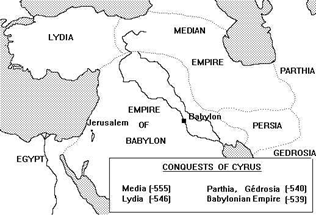
Historically, Malachi (c.465-420 BC) speaks to the third wave of expatriate Jews returning to Judah and Jerusalem after 70-years of exile in Babylon, and after Zerubbabel completed rebuilding the temple in Jerusalem in 516 BC. Just as the Jews’ first entrance into Canaan was quite miraculous by the hand of God working in Joshua and his armies, so was their second re-entrance.  They received a royal edict from the newly dominant world super-power, the Persian empire, and its God-empowered king named Cyrus.  It fulfilled Isaiah’s prophecy (45:1-3) during Hezekiah’s reign:  Thus saith the LORD to his anointed, to Cyrus, whose right hand I have holden, to subdue nations before him; and I will loose the loins of kings, to open before him the two leaved gates; and the gates shall not be shut; I will go before thee, and make the crooked places straight: I will break in pieces the gates of brass, and cut in sunder the bars of iron: And I will give thee the treasures of darkness, and hidden riches of secret places, that thou mayest know that I, the LORD, which call thee by thy name, am the God of Israel.  That was penned 150 years before Cyrus was born! [1]


Such a prophecy was quite bold, since the most feared nations were the Assyrians, who were later sub-jugated by the neo-Babylonians.  Persia was oh-so-far to the east; yet, true to God’s Word, Cyrus the Great began a conquering sweep counterclock-wise across the region and dominated the Medes, the Lydians and the Babylonians – and thus ruling over Judah and Jerusalem in the process. [2]
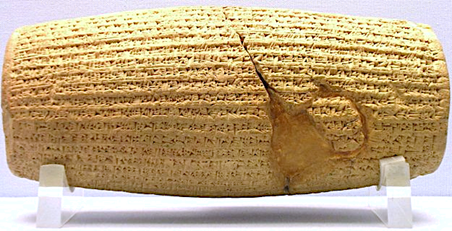
 

Cyrus the Great’s conquests are not questioned, but his edict of 538 AD as recorded in 2 Chronicles 36:22-23 is:  Now in the first year of Cyrus king of Persia, that the word of the LORD spoken by the mouth of Jeremiah might be accomplished, the LORD stirred up the spirit of Cyrus king of Persia, that he made a proclamation throughout all his kingdom, and put it also in writing, saying, Thus saith Cyrus king of Persia, All the kingdoms of the earth hath the LORD God of heaven given me; and he hath charged me to build him an house in Jerusalem, which is in Judah. Who is there among you of all his people? The LORD his God be with him, and let him go up. Throughout the 19th century, sceptics mocked the Bible’s claim that a king would allow such a thing.


The sceptics were silenced in 1879 when evangelical Christian and archaeologist Hormuzd Rassam discovered the Cyrus Cylinder in Babylonian ruins in Iraq.  The baked clay cylinder, approx. 9” x 4”, was  written in Akkadian cuneiform script with 36 lines of preserved text. “The Cyrus Cylinder establishes beyond doubt that it was Cyrus’ policy to return ‘them [exiles] to their settlements,’ and make ‘permanent sanctuaries’ for the gods of the exiled peoples. Moreover, he returned captured idols ‘unharmed to their cells, in the sanctuaries that make them happy.’ In the case of the Jews, however, since they had no idols, the gold and silver articles taken from the Temple were returned. The specific proclamation pertaining to the Jews is documented in Ezra 6:3–5.” [3]  Hailed as the first declaration of human rights (hah!), a copy resides at the UN headquarters.  Isaiah and God were right after all!
 

Like this? Consider sharing it to Facebook by clicking the linked icon below.

"For much of his adult life, Jesus resided in the small fishing village of Capernaum on the Sea of Galilee. It was here during the infancy of early Christianity that He began His ministry in the town synagogue (Mark 1:21)

“For much of his adult life, Jesus resided in the small fishing village of Capernaum on the Sea of Galilee. It was here during the infancy of early Christianity that He began His ministry in the town synagogue (Mark 1:21), recruited His first disciples (Mark 1:16–20) and became renowned for His power to heal the sick and infirm (Mark 3:1–5).

Early travelers to the site had long recognized the beautifully preserved remains of the ancient synagogue that many believe marked the site, if not the actual building, of Jesus’ earliest teaching. But an important detail of how Christianity began still remained: Where in the town had Jesus actually lived? Where was the house of Peter, which the Bible suggests was the home of Jesus in Capernaum (Matthew 8:14–16)?

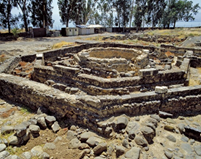
Italian excavators working in Capernaum may have actually uncovered the remnants of the humble house of Peter that Jesus called home while in Capernaum. Buried beneath the remains of an octagonal Byzantine martyrium church, excavators found the ruins of a rather mundane dwelling dating to the first century B.C.

Although slightly larger than most, the house was simple, with coarse walls and a roof of earth and straw. Like most early Roman-period houses, it consisted of a few small rooms clustered around two open courtyards. Despite later proving to be one of the most exciting Biblical archaeology discoveries, the house appeared quite ordinary. According to the excavators, however, it is what happened to the house after the middle of the first century A.D. that marked it as exceptional and most likely the house of Peter, the home of Jesus in Capernaum.

In the years immediately following Jesus’ death, the function of the house changed dramatically. The house’s main room was completely plastered over from floor to ceiling—a rarity for houses of the day. At about the same time, the house’s pottery, which had previously been household cooking pots and bowls, now consisted entirely of large storage jars and oil lamps. Such radical alterations indicate that the house no longer functioned as a residence but instead had become a place for communal gatherings, possibly even the first Christian gatherings, a key factor in how Christianity began. As with many Biblical archaeology discoveries, often the small details most convincingly tie ancient material remains to Biblical events and characters.

For instance, the excavators found that during the ensuing centuries, the plastered room from the original house had been renovated and converted into the central hall of a rudimentary church. The room’s old stone walls were buttressed by a newly built two-story arch that, in turn, supported a new stone roof. The room was even replastered and painted over with floral and geometric designs of various colors.

The building’s key role in understanding how Christianity began was confirmed by more than a hundred graffiti scratched into the church’s walls. Most of the inscriptions say things like “Lord Jesus Christ help thy servant” or “Christ have mercy.” They are written in Greek, Syriac or Hebrew and are sometimes accompanied by etchings of small crosses or, in one case, a boat. The excavators claim that the name of Peter is mentioned in several graffiti, although many scholars now dispute these readings.

This simple church building, helpful in determining how Christianity began, survived for more than 300 years before it was finally replaced in the fifth century by a well-built octagonal martyrium church. Octagonal martyria were built to commemorate an important site, such as the original house of Peter that once stood here. The inner sanctum of the octagonal building was built directly above the remains of the very room of the first-century house that had formed the central hall of the earlier church.

Biblical archaeology discoveries are not cut-and-dry cases. Though there is no definitive proof in this instance that the house ruin uncovered by the excavators actually is the ancient house of Peter, there is layer upon layer of circumstantial evidence to support its importance in early Christianity and its association with Jesus in Capernaum and his foremost disciple, Peter. Were it not for its association with Jesus and Peter, why else would a run-of-the-mill first-century house in Capernaum have become a focal point of Christian worship and identity for centuries to come?” [1]  From Biblical Archaeology Review, vol 35, 2009.


Like this? Consider sharing it to Facebook by clicking the linked icon below.

The prophecy of this book is entitled, The burden of the word of the Lord (v.1), which intimates, (1.) That it was of great weight and importance; what the false prophets said was light as the chaff, what the true prophets said was ponderous as the wheat, Jer. 23:28.

The prophecy of this book is entitled, The burden of the word of the Lord (v.1), which intimates, (1.) That it was of great weight and importance; what the false prophets said was light as the chaff, what the true prophets said was ponderous as the wheat, Jer. 23:28. (2.) That it ought to be often repeated to them and by them, as the burden of a song. (3.) That there were those to whom it was a burden and a reproach; they were weary of it and found themselves so aggrieved by it that they were not able to bear it. (4.) That to them it would prove a burden indeed, to sink them to the lowest hell, unless they repented. (5.) That to those who loved it and embraced it, and bade it welcome, though it was a light burden, as our Saviour calls it (Mt. 11:30), yet it was a burden.

This burden of the word of the Lord was sent, (1.) To Israel, for to them pertained the lively oracles of prophecy as well as those of the written word. Many prophets God had sent to Israel, and now he will try them with one more. (2.) By Malachi, by the hand of Malachi, as if not a message by word of mouth, but a letter put into his hand, for the greater certainty.

In these verses, they are charged with ingratitude, in that they were not duly sensible of Godʾs distinguishing goodness to them; and such a charge as this may well be called a burden, for it is a heavy one.

I. God asserts the great kindness he had, and had often expressed, for them (v.2): I have loved you, saith the Lord. Thus, abruptly does the sermon begin, as if God intended, whatever reproofs should be given them, to reconcile them to his love, and to take care that they should still have good thoughts of him. As many as I love I rebuke and chasten. Thus, kindly does the sermon begin. God will have his people satisfied that he loves them and is ever mindful of his love. This is the same with what he said of old to the virgin of Israel, that he might engage her affections to himself (Jer. 31:3-4): Yea I have loved thee with an everlasting love. In this one word God sums up all his gracious dealings with them; love was the spring of all; he loved them because he would love them (Deu. 7:7-8), loved them in their childhood, Hos. 11:1. His delight was in them, Isa. 62:4. "I have loved you, but you have not loved me, nor made any suitable returns for my love." Note, God’s people need be often reminded of his love to them.

II. They question his love, and diminish the instances of it, and seem to quarrel with him for telling them of it: Yet you say, Wherein hast thou loved us? As God traces up all his favours to them to the fountain, which was his love, so he traces up all their sins against him to the fountain, which was their contempt of his love. Instead of acknowledging his kindness, and studying what they shall render, they scorn to own that they have been beholden to him, challenge him to produce proofs of his love that are material, and think and speak very slightly of the instances they have had of his kindness, as if they were so few, so small, as not to be worth taking notice of, and no more than what they had sufficiently made returns for, or at least than he had sufficiently balanced with instances of his wrath. "Have we not been wasted, impoverished, and carried captive; and wherein then hast thou loved us?" Note, God justly takes it very ill to have his favours slighted, as not worth speaking of; and it is very absurd for us to ask wherein he has loved us, when, which way soever we look, we meet with the proofs and instances of his love to us.

III. He makes it out, beyond contradiction, that he has loved them, loved them in a distinguishing way, which was in a special manner obliging. For proof of this he shows the difference he had made, and would still make, between Jacob and Esau, between Israelites and Edomites. Some read their question, Wherefore hast thou loved us? as if they did indeed own that he had loved them, but withal insinuate that there was a reason for it - that he loved them because their father Abraham had loved him, so that it was not a free love, but a love of debt, to which he replies, "Was not Esau as near akin to Abraham as you are? Was he not Jacobʾs own brother, his elder brother? And therefore, if there were any right to a recompence for Abrahamʾs love, Esau had it, and yet I hated Esau and loved Jacob."

Let them see what a difference God had made between Jacob and Esau. Esau was Jacobʾs brother, his twin-brother: "Yet I loved Jacob and I hated Esau, that is, took Jacob into covenant, and entailed the blessing on him and his, but refused and rejected Esau." Note, those that are taken into covenant with God, that have the lively oracles and the means of grace committed to them, have reason to look upon these as tokens of his love. Jacob is loved, for he has these, Esau hated, for he has not. The apostle quotes this (Rom. 9:13), and compares it with what the oracle said to Rebecca concerning her twins (Gen. 25:23), The elder shall serve the younger, to illustrate the doctrine of Godʾs sovereignty in dispensing his favours; for may he not do what he will with his own? Esau was justly hated, but Jacob freely loved; even so, Father, because it seemed good in thy eyes, and it is not for us to ask why or wherefore.


Like this? Consider sharing it to Facebook by clicking the linked icon below.