Missives

A collection of apologetic and encouraging notes for Christians in need of some power-boosts from time to time.

"Your previous leaders are liars. They claim rights to the throne, but God gave me the victory." To ensure all subjects of the land heard his view, the new ruler posted it along a widely travelled thoroughfare.

“Your previous leaders are liars. They claim rights to the throne, but God gave me the victory.” To ensure all subjects of the land heard his view, the new ruler posted it along a widely travelled thoroughfare. This modern messaging approach was used by King Darius I who ascended to the Persian Achaemenid Dynasty in 522 BC. He had no blood relation to the preceding kings or princes from the empire’s founder Cyrus the Great, so a nation-wide rebellion broke out at his coronation. After brutally crushing the opposition, he made sure everyone knew about it. He carved an 82-foot by 49-foot cuneiform billboard on the side of Mount Behistun, 330 feet above the plain near Persepolis in the western Iranian province of Kermanshah in three official languages: old Persian, Elamite (Susian), and Babylonian (Akkadian) (see picture, below). This inscription is to cuneiform what the Rosetta Stone is to Egyptian hieroglyphs:  the ability to decipher the lost ancient languages of Persia, Assyria and Babylonia.  
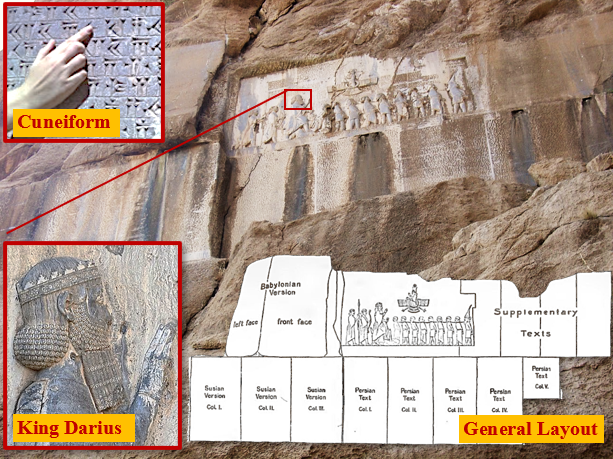
Behistun Inscription, Western Iran, contains King Darius I's account of his 550 BC regnal ascension in three (3) different cuneiform scripts of Assyria, Babylonia and Persia. Top left inset: Akkadian (cuneiform) script sample.  Bottom left inset: King Darius.  Bottom right inset: General layout.

  It predates the Rosetta Stone (196 BC) by 326 years and could have been the example which later kings emulated to write their version of history for a conquered land’s diverse but primary people groups.

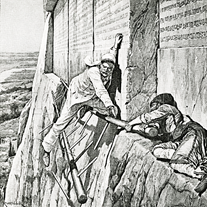
How men deciphered the inscription is another fascinating piece of history. Darius’ men wrote high on the mountain face then destroyed the rock ledge on which the carvers stood. This prevented others from defacing it; in fact, only weather damage to the limestone rock is found. It also means you can’t get up close to read it. Europeans as early as 1598 AD discovered the inscription, but it wasn’t until 1835 when Sir Henry C. Rawlinson, an English military officer, sat in suspended cages or dangled from scaffolds and ropes over four years to obtain a complete copy of the inscription (see illustration, right). In 1838, Rawlinson translated the old Persian first, then 18 years later used it to make sense of the Elamite and Babylonian portions. In 1948, University of Michigan Professor Cameron took photographs and casts to obtain more accurate transcriptions after Allied bombers used it for target practice. In 2006 it was listed as a UNESCO world heritage site.
The Bible records that Israel’s northern tribes were carried captive into Assyria (2 Kings 15:29), whose kingdom later fell to Babylon (Jeremiah 50:17), then to the Persians who were subjugated by King Darius I (Ezra 4:24, 5:17). The Behistun inscription gives evidence of Assyrian and Babylonian names for “Israel” (“Khumri” or “Gimiri”, as in the “House of Omri”) and “House of Isaac” used in Genesis 21:12 and Amos 7:16 (“Sak”, plural “Sacae”). Josephus noted about a million Jews who moved north through Armenia into what is now Ukraine and referred to them as Scythians consisting of Sacae and other nomadic groups. If Josephus is correct, we see three contrasts of Greek versus Jew in Colossians 3:11a, where there is neither Greek nor Jew, circumcision nor uncircumcision, Barbarian, Scythian.  Regardless, God’s word is the only reliable source of truth, whether of ancient history, geology, biology - and especially morality.

Sources: Compiled from PersiaBabylonia.org, Bible-History.com, Wikipedia and WorldHistory.org. Hope-of-Israel.org offers a Scythian-to-Saxon lineage this author couldn’t validate.  Illustration of Sir. H.C. Rawling from LookAndLearn.com.


Like this? Consider sharing it to Facebook by clicking the linked icon below.
In Judges 6 we read about Gideon, an Old Testament hero of faith who lived around 1,200 BC before the days of Israel's kings. Gideon was directly tasked by the Lord to destroy the altar of Baal in spite of being the youngest in his family.

In Judges 6 we read about Gideon, an Old Testament hero of faith who lived around 1,200 BC before the days of Israel’s kings. Gideon was directly tasked by the Lord to destroy the altar of Baal in spite of being the youngest in his family. After Gideon destroyed it by night because he feared his father's household, and the men of the city, he invoked the wrath of the town. When they came out in protest (bring him out that he may die), the basis for his new name was given by Joash his father: Will ye plead for Baal? will ye save him? he that will plead for him, let him be put to death whilst it is yet morning: if he be a god, let him plead for himself, because one hath cast down his altar. Therefore on that day he called him [Gideon] ‘Jerubbaal’, saying, ‘Let Baal plead against him’.


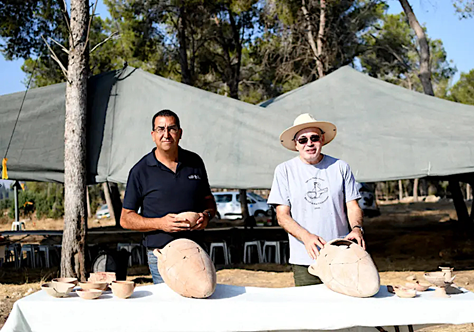
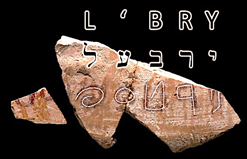
3,100 years later, and 27 miles southwest of Jerusalem, a 1-liter jug bearing his new name was found in strata dating to ~1,100 BC from the Khirbat er-Ra’i archaeological site.  It was found by excavators working under direction of Professors Garfinkel and Ganor (see photo below, with inset picture of the fragment), funded by the Israel Antiquity Authority.

Hebrew University of Jerusalem professors Yosef Garfinkel and Sa'ar Ganor on site, Shahariya Forest, Judean foothills, 2019.  Of their find, they wrote: “The name Jerubbaal only appears in the Bible in the period of the Judges, yet now it has also been discovered in an archaeological context, in a stratum dating from this period.”

It is highly rare and unusual for anyone to find any writing from the 12th to 11th century BC, so this is a big deal; so rare in fact, that most researchers don’t even know what their alphabet looked like back then.  Previously some argued that the alphabet was unknown in that region, so there couldn’t be any scribes, and thus the book of Judges was written much later –in the 9th century BC– which calls into question its reliability. Now we have smashing proof otherwise.

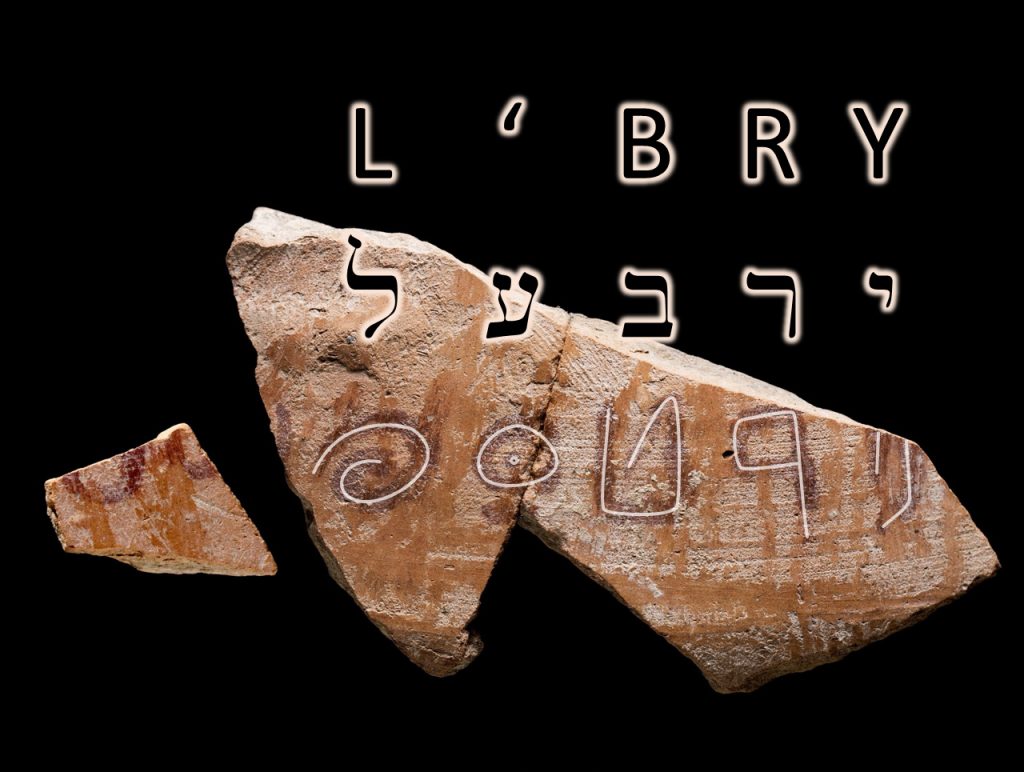
Epigraphic expert Prof. Christopher Rolston of George Washington University (DC) deciphered the fragment. The picture to the right shows the early Hebrew letters yod (broken at the top), resh, bet, ayin, lamed. Put together from right to left, you have Jerubbaal, Gideon’s new name.  Professor Garfinkel noted this Jerubbaal inscription is the “only inscription that has been discovered from the time of the judges, and it also just happens to have the name of a judge on it. This is unbelievable.”

Archaeologists cannot rule out that it actually did not belong to Gideon, in spite of the distance between where Gideon lived (30 miles north of Jerusalem) and the excavation site; however, it is clear evidence of a Biblical name in their day. It uses an early Hebrew word and letters consistent with the Early Iron Age. Evidently, the name Jerubbaal was in common usage at the time of the Biblical Judges.

Jerubbaal (Gideon) went on to defeat the Midianite army with 300 men using a trumpet in every man's hand, with empty pitchers, and lamps within the pitchers. Just as Gideon’s jug-n-light approach pushed the marauding Midianites far away from God’s people, so the use of his name written on a potsherd throws a powerful light for Biblical historical accuracy, trumpeting God’s truth, and once again chases away every high thing that exalteth itself against the knowledge of God.


Sources: https://www.smithsonianmag.com/smart-news/3000-year-old-jug-holds-name-biblical-judge-180978159/, https://www.allisrael.com/did-archaeologists-find-gideon-s-jug-rare-inscription-bears-the-name-jerubbaal, https://armstronginstitute.org/5-gideon-the-judge-found-in-southern-israel. Deciphered photo: https://crossroadsbible.net/wp-content/uploads/2021/07/Jerubbaal-ostracon-1024x772.jpg


Like this? Consider sharing it to Facebook by clicking the linked icon below.
Those goofy Jews. Why, they couldn't even write Hebrew until they stumbled across the Jordan desert, ended their nomadic life and assimilated themselves among modern Canaanite cities around 1,200 BC.

Those goofy Jews.  Why, they couldn’t even write Hebrew until they stumbled across the Jordan desert, ended their nomadic life and assimilated themselves among modern Canaanite cities around 1,200 BC.  To upscale their boorish history, Jewish zealots made up an Exodus story some 600 years later, indoctrinating wild fantasy into widely held facts among her influential theological leaders and across the entire Semitic community.

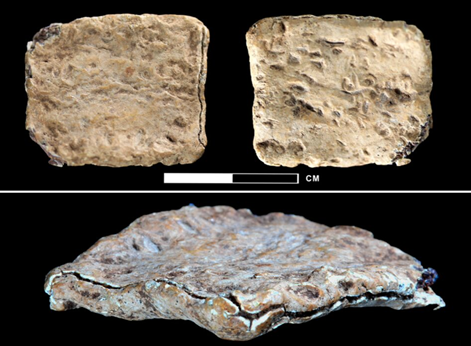
Or maybe not.  In 2019 Dr. Scott Stripling of the Archeological Studies Institute (Katy, TX) was wet sifting discarded material from a site atop of Mount Ebal excavated some 30 years prior.  He discovered a postage-stamp-sized folded tablet recognized as a defixio, Latin for “curse tablet” (below).  It is over 3,000 years old.  Too fragile to manipulate, he employed four scientists from the Czech Republic’s Academy of Sciences to digitally unfold it using 3D tomographic scans, and two Jewish epigraphers from the University of Haifa to decipher the ancient text. 

Hebrew curse tablet found on Mt. Ebal, in the Samaria mountains, West Bank.  Photo source: https://armstronginstitute.org/686-breaking-news-ancient-hebrew-curse-tablet-discovered-at-joshuas-altar-on-mt-ebal

The forty letters found inside translate as: “Cursed, cursed, cursed – cursed by the God YHW.  You will die cursed.  Cursed you will surely die.  Cursed by YHW – cursed, cursed, cursed.” This tablet remarkably parallels Deut. 11:26-29, 27:11-26, and Joshua 8:30-35, where Moses instructs the Jews to antiphonally repeat blessings of obedience and cursings of disobedience upon entering Canaan:  And it shall come to pass, when the LORD thy God hath brought thee in unto the land whither thou goest to possess it, that thou shalt put the blessing upon mount Gerizim, and the curse upon mount Ebal. A curse tablet would have been produced on the mount to remind subsequent generations of those vows – and it’s working to this day.

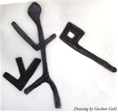
There are enormous implications wrapped in this tiny artifact. It’s written with an iron pen on a lead tablet, giving tangible proof as to how the ancients wrote permanent legal documents; as Job laments, Oh that my words … were graven with an iron pen and lead … forever! It contains the earliest reference to YWH (yah-weh, or Jehovah; Lord in the KJV) written in proto-alphabetic script (depicted, right).  It dates between 1400-1200 BC, consistent with the Biblical timeframe. This text predates the Dead Sea Scrolls by ~1,350 years and is at least 200 years older than any other Hebrew text in existence.  It offers weighty support towards Moses’ literacy, the Exodus timeframe, and the Canaanite conquest. Prof. Gershon Galil, one of the epigraphers, believes it is “absolutely the most important inscription ever found in Israel.”  This lead amulet is now cursing all Biblical minimalists!
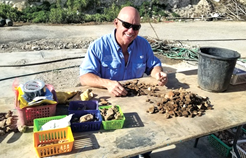
Dr. Stripling (right) plans to officially publish his discovery later in 2022 after he deciphers the tablet’s exterior inscriptions.  He notes the amulet’s author was a brilliant leader, writing in a chiastic form, and even teases that Joshua may have written it.  Stay tuned for more announcements, by googling “Hebrew curse tablet”, or watch Associates for Biblical Research YouTube videos.



From various sources:  Houston Chronicle article, Christianity Daily, Patterns of Evidence, Israel’s Armstrong Institute, and the Jerusalem Post.


Like this? Consider sharing it to Facebook by clicking the linked icon below.

In an earlier missive, you read about the struggles and challenges involved with promoting proper blueberry fruit growth. Since the first berries ripen around the first of June, this is an ideal time to update you on whether or not the pruning efforts actually worked. It appears that they did, as evidenced in the picture below taken June 11th.

In an earlier missive, you read about the struggles and challenges involved with promoting proper blueberry fruit growth. Since the first berries ripen around the first of June, this is an ideal time to update you on whether or not the pruning efforts actually worked. It appears that they did, as evidenced in the picture below taken June 11th.

Firstfruits of the "Bluecrop" variety of blueberry, after its second year of heavy pruning, and in its 10th year of production.  The year prior, the blueberries were as small as BB's.  Heavy pruning concentrates the plant’s energy towards relatively fewer -but larger- berries.

What you see are the first fruits of a nice crop of blueberries at the top of my formerly spindly plant. By cutting out the weak and smaller branches (whips) that sapped the plant’s energy, a greater concentration of nutrients went to berry-producing laterals.  This yielded larger berries, even at the top of a 5-foot plant. Thus far, the plant is on track for a bumper crop of nice market-grade produce, not the tiny useless berries as before.  Throughout this process, I’m reminded of some important spiritual lessons.


It is taught in scripture that, in the church of God, pruning is a necessary function. When some individuals, let’s call them the seed of the wicked, are sown (i.e., appear, or creep) in the midst of the brethren, they may look like fruit-bearing people, but they only serve to distract, pick on, or eat up the faithful. Bouncing from one crisis to the next, the ministers of God’s word cannot focus on feeding the flock; and as a result, you are left with anemic Christians. This isn’t healthy for the church, for you, or the minister as it tends to burn him out.


As harsh as it may sound, such need to be cut out. I believe this is the spiritual thrust of what Jesus means when He said: And if thy right eye [or right hand] offend thee, pluck it out, and cast it from thee: for it is profitable for thee that one of thy members should perish, and not that thy whole body should be cast into hell.  Jesus is not teaching self-mutilation, as your hand does not operate apart from your will; you’d have to cut out your brain along with your hand to affect any real change, if we are to understand this physically.  Paul wrote: for as the body is one, and hath many members, and all the members of that one body, being many, are one body; so, Jesus is speaking about the church.  These offenders need to be confronted, and given space to repent.  If it bear fruit, well: and if not, then after that thou shalt cut it down. Paul told a church to deliver such an one unto Satan for the destruction of the flesh, that the spirit may be saved in the day of the Lord Jesus.    


Spiritual pruning is directed throughout scripture. (Proverbs 22:10) Cast out the scorner, and contention shall go out; yea, strife and reproach shall cease.  (Romans 16:16-17) Salute one another with an holy kiss. The churches of Christ salute you. Now I beseech you, brethren, mark them which cause divisions and offences contrary to the doctrine which ye have learned; and avoid them. Notice Paul’s contrast.  Some you kiss, and some you dismiss.  John wrote of a rather extreme case:  (3John 1:9-10) I wrote unto the church: but Diotrephes, who loveth to have the preeminence among them, receiveth us not. Wherefore, if I come, I will remember his deeds which he doeth, prating against us with malicious words: and not content therewith, neither doth he himself receive the brethren, and forbiddeth them that would, and casteth them out of the church.


Pray that God would keep our “church garden” free and clear of fruit-robbing weeds and bad branches. Herein is my Father glorified, that ye bear much fruit; so shall ye be my disciples.


Like this? Consider sharing it to Facebook by clicking the linked icon below.

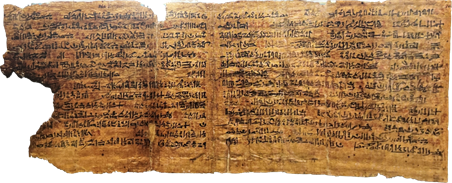
In 1828, the Dutch government purchased a papyrus (below) from the antiquities market. Written in ancient Egyptian cursive (heiratic) style in black and red ink, it runs across 17 columns and 236 lines.

In 1828, the Dutch government purchased a papyrus (below) from the antiquities market.  Written in ancient Egyptian cursive (heiratic) style in black and red ink, it runs across 17 columns and 236 lines. The 7-inch-wide scroll measures over 12 feet (!), and dates to the 18th or 19th Egyptian Dynasty, around 1300 BC. The strange artifact is a sad poem of a time when Egypt was hammered with nationwide chaos, far-reaching destruction, inexplicable plagues, and death of both man and beast.

"The Admonitions of Ipuwer" (Papyrus Leiden I-344) resides at the Dutch National Museum of Antiquities, Leiden.  It dates to around 1,300 BC, approx. 150 years after the Exodus.

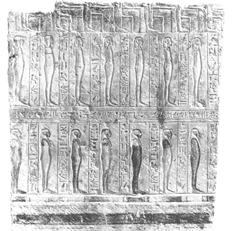
Ipuwer, the author, may be the same man whose figure was depicted on a 19th Dynasty tomb wall (right) at Sakkara.  Titled as “overseer of singers”, he was noted as a famous author and poet. Ipuwer laments Egypt’s servants rising into power, all nature turning upside down, and the gods either leaving Egypt or becoming useless right alongside of Pharaoh.  In fact, Ipuwer’s poems offer stunning parallels to 8 of Moses’ 10 plagues of Egypt prior to the Exodus (see table, right). This appears to be the Egyptian’s side of the story when God took vengeance upon Egypt!

* Source: Titus Kennedy, “Bible and Spade”, Vol. 35 No. 1, 2022, pgs. 23-32.


Plague

Bible passage

Ipuwer citation

1. Water to blood

(Ex. 7:20b,21b) … all the waters that were in the river were turned to blood.  … the Egyptians could not drink of the water of the river; and there was blood throughout all the land of Egypt.

(2.10) the river is blood, as one drinks of it one shrinks from people, and thirsts for water … (2.6) throughout the land, blood is everywhere

4. Swarm of flies

(Ex. 8:24) there came a grievous swarm of flies … into all the land of Egypt: the land was corrupted by reason of the swarm of flies.

While not directly mentioned, he writes of their effects: (2.11-12) towns are ravaged, Upper Egypt became wasteland … land is injured

5. Pesti-lence

(Ex. 9:3b) Behold, the hand of the LORD is upon thy cattle … there shall be a very grievous murrain. (6b) all the cattle of Egypt died

(2.5-6) Pestilence is throughout the land … there is no lack of death (5.5) … cattle mourn because of the state of the land

6. Boils

(Ex. 9:9a) it shall become small dust in all the land of Egypt, and shall be a boil breaking forth with blains upon man, and upon beast (11a) magicians could not stand before Moses because of the boils

(4.1-3) Hair has fallen out for everyone; the son of a man cannot be distinguished from the pauper … great and small say, ‘I wish I could die!’

7. Hail and fire storms

(Ex. 9:23b) the LORD sent thunder and hail, and the fire ran along upon the ground… (25) And the hail smote throughout all the land of Egypt all that was in the field, both man and beast; and the hail smote every herb of the field, and brake every tree of the field.

(4.11-5.1) Trees are swept away, plantations laid bare … destroyed are loaves in abundance for the children. (7.1) For look, the fire has become higher; its burning should come forth against the enemies of the land (2.10) Porches, pillars, and walls are burnt …

8. Swarm of locusts

(Ex. 10:14a) the locusts went up over all the land of Egypt … (15b) … they did eat every herb of the land, and all the fruit of the trees … there remained not any green thing in the trees, or in the herbs of the field

Locusts are not specifically mentioned, but their effects are:

(6.2) birds find neither fruit nor herbs (6.3) seed is taken from the pig’s mouth. … barley has perished everywhere. (5.2-3) Officials are hungry and homeless

9. Dark-ness

(Ex. 10:22b) … there was a thick darkness in all the land of Egypt three days

(9.11) Day does not dawn on it [land of Egypt] (2.5-6) There is no pilot [i.e., their sun god Ra] on duty

10. Death of firstborn

(Ex. 11:5) all the firstborn in the land of Egypt shall die … and all the firstborn of beasts.

(2.13-14) He who places his brother in the earth is everywhere (3.13-14) Laughter has perished … mourning throughout the land

Plunder

(Ex. 12:35b) they borrowed of the Egyptians jewels of silver… (36b) … they spoiled the Egyptians.

(3.2-3) Gold, lapis, lazuli, silver, … our fine stones have been hung on the necks of maidservants


Like this? Consider sharing it to Facebook by clicking the linked icon below.

Our Lord Jesus, in the night wherein He was betrayed, instituted the Sacrament of His body and blood, called the Lord's Supper, to be observed in His Church unto the end of the world...

I. Our Lord Jesus, in the night wherein He was betrayed, instituted the Sacrament of His body and blood, called the Lord’s Supper, to be observed in His Church unto the end of the world, for the perpetual remembrance of the sacrifice of Himself in His death, the sealing all benefits thereof unto true believers, their spiritual nourishment and growth in Him, their further engagement in and to all duties which they owe unto Him; and to be a bond and pledge of their communion with Him, and with each other, as members of His mystical body.


II. In this Sacrament Christ is not offered up to His Father, nor any real sacrifice made at all for remission of sins of the quick or dead; but only a commemoration of that once offering up of Himself, by Himself, upon the cross, once for all; and a spiritual oblation of all possible praise unto God for the same: so that the Popish sacrifice of the mass, as they call it, is most abominably injurious to Christ’s one only sacrifice, the alone propitiation for all the sins of the elect.


V. The outward elements in this Sacrament, duly set apart to the uses ordained by Christ, have such relation to Him crucified, as that truly, yet sacramentally only, they are sometimes called by the name of the things they represent, [that is], the body and blood of Christ; albeit, in substance and nature, they still remain truly, and only, bread and wine, as they were before.


VI. That doctrine which maintains a change of the substance of bread and wine into the substance of Christ’s body and blood (commonly called transubstantiation) by consecration of a priest, or by any other way, is repugnant, not to Scripture alone, but even to common sense and reason; overthroweth the nature of the Sacrament; and hath been, and is the cause of manifold superstitions, yea, of gross idolatries.


VII. Worthy receivers, outwardly partaking of the visible elements in this Sacrament, do then also inwardly by faith, really and indeed, yet not carnally and corporally, but spiritually, receive and feed upon Christ crucified, and all benefits of His death: the body and blood of Christ being then not corporally or carnally in, with or under the bread and wine; yet as really, but spiritually, present to the faith of believers in that ordinance, as the elements themselves are to their outward senses.


VIII. Although ignorant and wicked men receive the outward elements in this Sacrament, yet they receive not the thing signified thereby; but by their unworthy coming thereunto are guilty of the body and blood of the Lord, to their own damnation. Wherefore all ignorant and ungodly persons, as, they are unfit to enjoy communion with Him, so are they unworthy of the Lord’s Table, and cannot, without great sin against Christ, while they remain such, partake of these holy mysteries, or be admitted thereunto.


Like this? Consider sharing it to Facebook by clicking the linked icon below.

Who is a "rich man"? This rather means one who loves his riches and makes an idol of them; or one who supremely desires to be rich.

Then said Jesus unto his disciples, Verily I say unto you, That a rich man shall hardly enter into the kingdom of heaven. And again I say unto you, It is easier for a camel to go through the eye of a needle, than for a rich man to enter into the kingdom of God. (Matthew 19:23-24)

Who is a “rich man”? This rather means one who loves his riches and makes an idol of them; or one who supremely desires to be rich. Mark says, them that trust in riches. While he has this feeling, it is literally impossible that he should be a Christian. For religion is the love of God, rather than the world; the love of Jesus and his cause, more than gold. Still a man may have much property, and not have this feeling. He may have great wealth, and love God more; or, a poor man may have little, yet love that little more than God. The difficulties in the way of salvation for a rich man are,

1st, that riches engross the affections.

2nd, that men consider wealth as the chief good; and when this is obtained, think they have gained all.

3rd, they are proud of their wealth, and are unwilling to be numbered with the poor and despised followers of Jesus.

4th, riches engross the time, and fill the mind with cares and anxieties, and leave little for God.

5th, they often produce luxury, dissipation, and vice.

6th, it is difficult to obtain wealth without sin, or without avarice, and covetousness, and fraud, and oppression. To these points, scriptures hold forth abundant warnings and exhortations.  Hear the Apostles:

But they that will be rich fall into temptation and a snare, and into many foolish and hurtful lusts, which drown men in destruction and perdition. For the love of money is the root of all evil: which while some coveted after, they have erred from the faith, and pierced themselves through with many sorrows. … Charge them that are rich in this world, that they be not highminded, nor trust in uncertain riches, but in the living God, who giveth us richly all things to enjoy. (1Timothy 6:9-10,17)

Go to now, ye rich men, weep and howl for your miseries that shall come upon you. Your riches are corrupted, and your garments are motheaten. Your gold and silver is cankered; and the rust of them shall be a witness against you, and shall eat your flesh as it were fire. Ye have heaped treasure together for the last days. Behold, the hire of the labourers who have reaped down your fields, which is of you kept back by fraud, crieth: and the cries of them which have reaped are entered into the ears of the Lord of sabaoth. Ye have lived in pleasure on the earth, and been wanton; ye have nourished your hearts, as in a day of slaughter. Ye have condemned and killed the just; and he doth not resist you. (James 5:1-6)

And he spake a parable unto them, saying, The ground of a certain rich man brought forth plentifully: And he thought within himself, saying, What shall I do, because I have no room where to bestow my fruits? And he said, This will I do: I will pull down my barns, and build greater; and there will I bestow all my fruits and my goods. And I will say to my soul, Soul, thou hast much goods laid up for many years; take thine ease, eat, drink, and be merry. But God said unto him, Thou fool, this night thy soul shall be required of thee: then whose shall those things be, which thou hast provided? So is he that layeth up treasure for himself, and is not rich toward God. (Luke 12:16-21)

There was a certain rich man, which was clothed in purple and fine linen, and fared sumptuously every day: And there was a certain beggar named Lazarus, which was laid at his gate, full of sores, And desiring to be fed with the crumbs which fell from the rich man's table: moreover the dogs came and licked his sores. And it came to pass, that the beggar died, and was carried by the angels into Abraham's bosom: the rich man also died, and was buried; And in hell he lift up his eyes, being in torments, and seeth Abraham afar off, and Lazarus in his bosom. And he cried and said, Father Abraham, have mercy on me, and send Lazarus, that he may dip the tip of his finger in water, and cool my tongue; for I am tormented in this flame. But Abraham said, Son, remember that thou in thy lifetime receivedst thy good things, and likewise Lazarus evil things: but now he is comforted, and thou art tormented. And beside all this, between us and you there is a great gulf fixed: so that they which would pass from hence to you cannot; neither can they pass to us, that would come from thence. (Luke 16:19-26)

Still Jesus says, with God all things are possible. God can give grace to have a righteous handling of riches. Though to men it may appear impossible, yet it is easy for God to give riches while withholding the love of it, lest it become idolatry unto us.


Like this? Consider sharing it to Facebook by clicking the linked icon below.

The New Testament's inclusion of specific members of society is actually quite insightful. Multiple accounts mention the class of centurion...

The New Testament’s inclusion of specific members of society is actually quite insightful.  Multiple accounts mention the class of centurion (Centurio); for instance, Matthew 8:5-13 (Jesus healed a centurion’s paralyzed servant), Acts 10:1 (Cornelius of the Italian regiment), Acts 22:25 (“take heed what thou doest [to Paul] for this man is a Roman”), Acts 23:23 (two centurions and their soldiers escorting Paul to safety to Felix the Governor), and Acts 28:16 (the centurion suffered Paul to dwell by himself with a soldier).  What can we know of their character, and what might it inform us about Jesus?

The Centurio originally led 100 soldiers (known as a century) but was later reduced to only 80 men. The basic Roman armed unit was the Legion, headed by a Legate, consisting of 5-6,000 soldiers and officers. Legions were divided into cohorts and further into centuries. Both divisions were led by centurions.

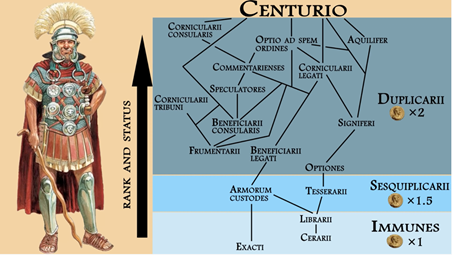
The lowest class was the Recruit, who after a 4-month trial joined the Milites class. If he was illiterate, his job was hard manual labor such as building a siege ramp.  Skilled recruits became Immunes who received the same pay but were exempt from physical labor.  They served as engineers, doctors, and musicians.  Recruits could rise to an Exacti (bookkeeper), Cerarii (wax provider), or Librarii (kept track of official documents). Their annual pay was 252 denari.

As skills and experience increased, so did their pay and responsibilities.  The Sesqiplicarii class received 1.5x base pay with the task of monitoring men and equipment. The Armorum Custodes safeguarded and maintained the weapons and the Tessararii served as the watch chief in charge of camp security. Exemplary soldiers achieved Duplicarii with twice the pay.  These officers included the Signiferi who bore the century standard plus other admin duties such as overseeing the soldiers’ financial payroll and benefits; Optiones were handpicked soldiers that were second in command; and Frumentarii managed the legion’s grain supply and food contracts or provided intel and surveillance services.  The Beneficiarii were trusted soldiers under a Legate (Legati) responsible for special assignments abroad (Consularis).  Others included the Aquilifer who carried the century’s unique eagle standard; the Speculatores who oversaw intelligence, arrests, and executions; Commentarienses who managed staff correspondence and decisions made by governors; Corniculari who served as the highest-ranking office heads to Tribunes, Legates or Governors; and Optio Ad Sem Ordines who awaited promotion.

Historians identified paths to promotion by analyzing Legionaires’ tombstones who rarely omitted carving their life’s career path.  Centurions were normally selected from the ranks of Duplicarii (see diagram below). Typically, one became a centurion after 13-20 years.  The most likely promotion path was through Tessararii, Beneficiarii or Speculatores.  By the time a man achieved the class, he would be well trained in battle, highly skilled at leadership, and well respected by his men - all critical skills for any military. Centurions always commanded from the front lines of battle, suffering similar wounds as the men under their command.  They would be called up by Governors for regional status and advice, and thus must be able to properly research facts and communicate them clearly to senior leadership. They were fully developed in multiple areas of expertise —intelligent, articulate, yet strong enough to fight alongside new recruits.  Centurions were a man’s man.

A centurion typically led 1 Optio, 2 Cornicularii, 2 Commentarienses, 10 Speculatores, 30-60 Beneficiarii, ~10 Frumentarii, and ~40 Immunes.   From Roman records, we read about Servanis, who led the 2nd Legion for 61 years, dying at age 86.  No wonder Julius Caesar thought of his centurions as the backbone of the Roman Army.  Not all centurions had equal responsibility.  The cohort level 2-10 Centurio led 80 men, while a cohort level 1 Centurio led 160 of the best men.  The Centurio Prefectus Castrorum directed over 1,000 men and provided region-wide camp management and logistics. Their modern equivalent rank would range from Major to 1-star Brigadier General. 

Jesus stunned several of these honorable and battle-hardened men with His words. At Jesus’ death on the cross, after crying in a loud voice, the centurion said surely this was the Son of God. Luke also records one responding, certainly this was a righteous man. Pontius Pilate, who would have been a high-ranking centurion, said I find no fault in this man. Jesus was, and is, the Lord of lords, the captain of the Lord’s host, and a man of war. This is hardly the limp-wristed, weak, effeminate “jesus” shown in movies!


Info and picture source: https://www.youtube.com/watch?v=fQXkokRE8K4


Like this? Consider sharing it to Facebook by clicking the linked icon below.

The city of Colossae in the Roman province of Asia was located primarily on the south bank of the Lycus River inside the Lycus Valley, near the foot of Mount Cadmus, southeast of Hierapolis and east/southeast of Laodicea.

“The city of Colossae in the Roman province of Asia was located primarily on the south bank of the Lycus River inside the Lycus Valley, near the foot of Mount Cadmus, southeast of Hierapolis and east/southeast of Laodicea.  In the 1st century, it seems that Colossae was a ‘town’ not as large or important as the nearby ‘city’ of Laodicea to which Colossae was contrasted. The fields around Colossae yielded produce such as olives and figs, and the many sheep pastured in the area contributed to a wool industry which included the production of a popular wool dyed dark red/purple. In the 1st century AD, Pliny wrote about the purple wool of Colossae’s fame, made with a dye from the cyclamen flower (left); the Latin word ‘collossinus’ (purple wool) seems to be derived from the name of the city.”

“Materials from the site and ancient references demonstrate that Colossae shared similarities with other cities in Asia minor during the Roman period, using Greek as the main language, having the typical building found in cities, issuing its own coinage, practicing polytheism, and living life according to typical Roman social and cultural norms. The people had families, servants, understood Greek, used Roman money, worshiped various deities, and worked primarily in the agricultural sector.”

“Although Colossae was possibly the smallest of the three cities in the valley, the letter was sent to the church there because of the personal connections of Paul to Epaphras, Philemon, and Onesimus, and because Onesimus was returning to Philemon in Colossae with Tychius (Col 4:7-9; Phm 10). Both Philemon, who was a church leader and host, and Onesimus, were members of the church in Colossae (Phm 1-2; Col 4:9). It is also possible that there was a much larger Christian community in Colossae at that time, but by around 90 AD and the writing of Revelation it had shifted to the major urban center of Laodicea, perhaps as a result of the earthquake in the region. The church in Colossae and the Lycus Valley apparently was established while Paul was living in Ephesus around 55 AD (Acts 19:10). The Christian who brought the Gospel to Colossae and the surrounding area and continued to be a leader in the church, Epaphras, had a name which has been found on a few Roman period inscriptions and seems to be a shortened form of Epaphroditus (Col 1:7, 4:12; Phm 23; Php 2:25, 4:18). Interestingly, an inscription found at Colossae contains the name T. Asinius Epaphroditus, demonstrating the use of the name in the Roman period at Colossae. Unlike many of the cities in Asia minor, Paul [indirectly brought] the Gospel to Colossae (Acts 19:10), and he may never have even visited the city (Col 2:1, 4:12-17). When Paul wrote to the Colossians, he was imprisoned (Acts 28:30-31).”

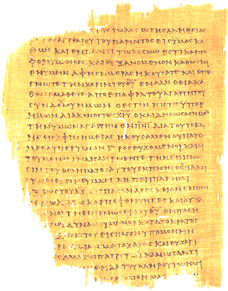
“Paul’s letter to Colossae … demonstrates that Christianity had spread to the Lycus Valley by the middle of the 1st century AD. Papyrus 46 (right), from 200 AD or earlier and found in distant Egypt, is a copy of Colossians that has preserved almost the entire letter, indicating its antiquity and authenticity. The epistle warned against heresies of religious syncretism, or combining and replacing beliefs of Christianity with other religions or worldviews (Col 2:8-23).  These problems with false teachers are understandable in light of the religious diversity of Colossae, which included Hellenistic and Roman religion and philosophy, Phrygian religion, and Judaism, and Paul actually mentions Greeks, Jews, barbarians, and Scythians in reference to those in the area of Colossae (Col 3:11). A Phrygian name, Apphia, … known from various inscriptions found in Phrygia, actually appears in a letter of Paul (Phm 2). Historical sources demonstrate that Jews had lived in the region of Phrygia from … about 200 BC; therefore, a considerable population of Jews, along with synagogues, would have been present in the area during the 1st century AD. The presence of multiple ethnic groups and religions at Colossae as described by Paul is also attested from several other sources.”
Dr. Titus Kennedy is a field archaeologist working primarily with sites and materials related to the Bible. He works with ColdWater Media and Drive Thru History® to maintain historical accuracy throughout their scripts and locations. Sources: https://drivethruhistory.com/colossae/ (excerpted); Photo of P46 (of Col 1:5-13) http://earlybible.com/manuscripts/p46-Col-2.html.


Like this? Consider sharing it to Facebook by clicking the linked icon below.

If any miracle of the Bible is going to attract the critics, the resurrection of Jesus from Joseph of Arimathea's new tomb after three days is a prime target.

If any miracle of the Bible is going to attract the critics, the resurrection of Jesus from Joseph of Arimathea’s new tomb after three days is a prime target.  After all, Jesus’ resurrection is the uniquely premier event of all human history.  For believer and unbeliever alike, it validates His words like nothing else can. It assures believers of their justification, regeneration and future resurrection as well. But to be honest, reconstructing the events on that glorious day is challenging due to a common narrative approach used by historians. They “telescope” information; meaning, some details are skipped to focus on key points (from their perspective). All gospel authors appear to use this technique.

Some of the challenges in harmonizing the gospel accounts lie in the following areas:  How many women went to the tomb, and when did they leave? When and where did they see Jesus?  Was the tomb already open? How many angels appeared?  This article is helped by Mr. Tim Chaffy who wrote a book, In The Defense of Easter: Answering Critical Challenges to the Resurrection of Jesus,[1] which provides some helpful observations and reasonable assumptions to make all the data plausibly fit.

First, it’s clear that multiple women first went to the tomb, early in the morning. Mary Magdalene is particularly called out in three gospels.  Luke names three women and says other women also went; thus, there are at least five who went. John only mentions Mary, but she told Peter they have taken away the Lord out of the sepulchre, and we know not where they have laid him. John is telescoped on Mary.  No conflicts seen here.

Mark, Luke and John all indicate the stone was already rolled away, but Matthew’s wording appears to differ:  behold, there was a great earthquake: for the angel of the Lord descended from heaven, and came and rolled back the stone from the door, and sat upon it. Matthew’s account isn’t a contradiction; he’s only reporting what already happened. Similarly, Matthew and Mark telescope to only focus on one angel, whereas Luke and John mention the two angels that are present.

The order of appearances is more challenging.  Matthew has the women visiting the tomb, see an angel, run to tell the disciples, then see Jesus on their way. Mark is explicit, however, that He appeared first to Mary Magdalene, and then, only after her return to the tomb with Peter and John.  How can both be true?  Why wouldn’t these women have crossed paths on their way?

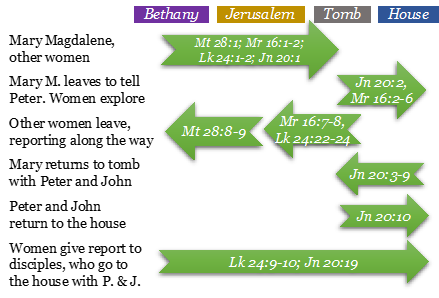
One reasonable assumption to make is that Peter and John, who followed Jesus to His trial in Jerusalem, returned to a different house afterwards, not to where all the other scattered disciples re-grouped, which likely was at Martha and Mary’s home in Bethany. This helps explain the timing of the sightings, as well as providing two different routes for the women.  Mr. Chaffy’s harmony of the resurrection day events is depicted in the graphic (below).

If the other disciples fled to Martha and Mary’s house in Bethany where Jesus often stayed on trips to Jerusalem, then the difficulties resolve nicely.  Mary Magdalene would have left before the other women explored the tomb and saw the angels. After they leave, Mary Magdalene returns with Peter and John (who leave shortly afterward) and sees Jesus first. The other women see Him on the way, report this to Clopas (Lk 24:22-24), and then to the other disciples.  They all eventually wind up in the house where Peter and John were at. What a glorious and chaotic day that must have been!


Like this? Consider sharing it to Facebook by clicking the linked icon below.